What Is Endpoint Security?
Trellix Endpoint Security Earns SE Labs’ Highest AAA Rating for Enterprise & Small Business Customers |
Read Now
Reviewed by Sanjay Raja · December 5, 2025
Endpoint security is the practice of securing endpoints or entry points of end-user devices such as servers, desktops, laptops, and mobile and supported Internet of Things (IoT) devices from being exploited by malicious actors and campaigns. Endpoint security systems protect these devices on a network or in the cloud from cybersecurity threats.
Webinar
Hunting with Trellix Endpoint Forensics
See how to uncover hidden threats, accelerate investigations, and minimize dwell time.
Endpoint security has evolved from traditional antivirus software to providing comprehensive protection from sophisticated threats and ever-changing zero-day exploits. Organizations of all sizes are at risk from nation-states, hacktivists, organized crime, and malicious and accidental insider threats.
Endpoint security is often seen as cybersecurity's frontline. It represents one of the first places organizations look to secure their enterprise networks. As the volume and sophistication of cybersecurity threats have steadily grown, so has the need for more advanced endpoint security solutions. Today’s endpoint protection systems are designed to quickly detect, analyze, block, and contain attacks before they can do damage.
To do so, they need to collaborate with each other and with other security technologies. This gives administrators visibility into advanced threats to speed detection and remediation response times.
What is considered an endpoint?
If a device is connected to a network, it is considered an endpoint. With the growing popularity of bring your own device (BYOD) and IoT, the number of individual devices connected to an organization's network can quickly reach into the tens—and hundreds—of thousands.
Endpoints span a range of devices such as:
Tablets
Mobile devices
Laptops
Smart watches
Printers
Servers
ATM machines
Medical devices
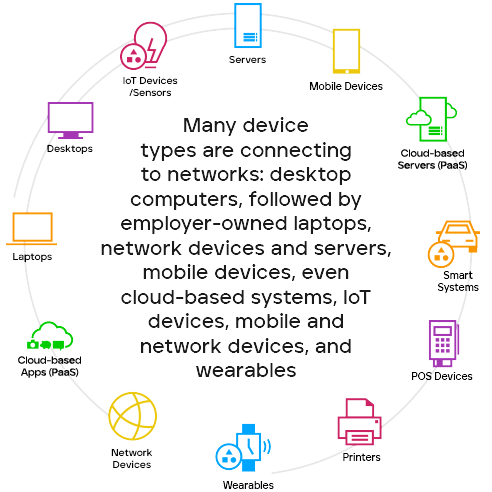
Because they are entry points for threats, malware and ransomware, endpoints—especially mobile and remote devices—are a favorite target of adversaries. Mobile endpoint devices have become much more than just Android devices and iPhones—think of the latest wearable watches, smart devices, voice-controlled digital assistants, and other IoT-enabled smart devices.
We now have network-connected sensors in our cars, airplanes, hospitals, and even on operational technology such as oil rig drills. As the different types of endpoints have evolved and expanded, the security solutions that protect them have also had to adapt.
Why is endpoint security important?
An endpoint protection platform (EPP) is a vital part of enterprise cybersecurity as the endpoint is a primary target for threat actors to gain access to your infrastructure. Businesses have to contend with not only a growing number of endpoints, but also a rise in the number of types of endpoints.
These factors on their own make enterprise endpoint security more difficult, but they’re compounded by remote work and BYOD policies—which make perimeter security increasingly insufficient and create vulnerabilities.
The threat landscape is becoming more complicated, as well: Hackers are always coming up with new ways to gain access, steal information, or manipulate employees into giving out sensitive information.
Added to this list are:
The opportunity cost of reallocating resources from meeting business goals to addressing threats
The reputational cost of a large-scale breach
The actual financial cost of compliance violations
Given all these challenges, it’s easy to see why EPPs have come to be regarded as must-haves for securing modern enterprises.
Endpoint security components
Typically, endpoint security software will include these key components:
Machine-learning classification to detect zero-day threats in near real time
Advanced antimalware and antivirus protection to protect, detect, and correct malware across multiple endpoint devices and operating systems
Proactive web security to ensure safe browsing on the web
Data classification and data loss prevention to prevent data loss and exfiltration
Integrated firewall to block hostile network attacks
Email gateway to block phishing and social engineering attempts targeting your employees
Actionable threat forensics to allow administrators to quickly isolate infections
Insider threat protection to safeguard against unintentional and malicious actions
Centralized endpoint management platform to improve visibility and simplify operations
Endpoint, email and disk encryption to prevent data exfiltration
Application and change control to prevent unauthorized users from making changes to existing applications, or installing new ones
How enterprise endpoint protection differs from consumer endpoint protection
Enterprise Endpoint Security Protection
Consumer Endpoint Security Protection
Scales seamlessly to hundreds of thousands of endpoints
Required to manage just a small number of single-user endpoints
Better at managing diverse collections of endpoints
Required to manage just a small number of single-user endpoints
Central management hub software
Endpoints individually set up and configured
Remote administration capabilities
Rarely requires remote management
Configures endpoint protection on devices remotely
Configures endpoint protection directly to device
Deploys patches to all relevant endpoints
User enables automatic updates for each device
Requires modified permissions
Uses administrative permissions
Ability to monitor employee devices, activity, and behavior
Activity and behavior limited to sole user
Top 5 endpoint protection benefits
Enhanced Security and Protection Against Cyber Threats. Endpoint protection safeguards users against sophisticated attacks and helps prevent potentially catastrophic outcomes like revenue loss, reputation damage, destructive data breaches, and business disruptions. Endpoint security software analyzes and vets all changes and movement of data, scanning for malware, ransomware, and viruses.
Faster Threat Response and Mitigation. Comprehensive solutions enable organizations to detect threats more quickly and improve response and mitigation times in the event of a breach. This capability is also important for helping organizations swiftly recover from breaches.
Robust Infrastructure Protection. Endpoint protection prevents unauthorized access to sensitive infrastructure and helps guard against data loss. Managing endpoints is necessary to secure assets such as corporate data, customer information, and intellectual property.
Simplified Security Management. Endpoint protection solutions automate many routine tasks, allowing security staff to focus on higher-value initiatives. A single console enhances visibility, enabling teams to manage all security policies and see all connected devices.
- Risk Mitigation and Rapid Patch Deployment. Endpoint protection enables risk mitigation by identifying and addressing potential vulnerabilities within the system. This is often achieved through the rapid deployment of the latest security features and technology.
How to choose an endpoint security solution— 3 questions to ask
To protect your business, you need a comprehensive and unified solution that shields devices and endpoints across your hybrid network. Here are three critical questions to ask when choosing an endpoint security solution:
Question #1: How comprehensive is the endpoint protection?
The solution you choose should proactively guard against threats using robust capabilities for prevention, detection, investigation, and response. It should allow you to gain visibility across your on-premises, cloud, and disconnected environments in a single agent and control all your endpoints.
Question #2: Does the endpoint security solution offer centralized management?
You need to be able to easily identify, scale, and manage hundreds of thousands of endpoints from a single console to eliminate security gaps and automate your workflows.
Question #3: Does the endpoint security solution enable proactive risk management?
Staying ahead of threats is key to warding off adversaries. Your endpoint security solution should provide AI-powered proactive threat prioritization, automated alert correlation, and MITRE ATT&CK mapping for predictive security posture assessments.
The CyberThreat Report
Insights gleaned from a global network of
experts, sensors, telemetry, and intelligence
How Trellix can help
Trellix endpoint security enables you to address complex, distributed security issues quickly and thoroughly.
Trellix Endpoint Security provides multilayered endpoint protection spanning your on-premises, cloud, hybrid, and disconnected environments in a single agent, and managed from a single source. It ensures all security components work seamlessly to provide robust protection across all vectors.
Trellix Endpoint Detection and Response with Forensics (EDRF) delivers comprehensive, proactive protection, enabling organizations to detect and respond to advanced threats more quickly and efficiently. By leveraging a unique blend of advanced analytics, AI-driven automation, and expert insights, it helps organizations stay ahead of emerging threats and secure their endpoints.
With Trellix, organizations can prevent, detect, investigate, and respond to threats and stay ahead of adversaries.
Endpoint security FAQ
- Tablets
- Mobile devices
- Laptops
- Smart watches
- Printers
- Servers
- ATM machines
- Medical devices
- Incursions from increasingly complex threats
- The loss of valuable company data or access to it
- Reputational damage from a major breach
- Costly compliance violations
Key components of endpoint security include:
- Machine-learning classification
- Advanced antimalware and antivirus protection
- Proactive web security
- Data classification and data loss prevention
- Integrated firewall
- Email gateway
- Actionable threat forensics
- Insider threat protection
- Centralized endpoint management platform
- Endpoint, email and disk encryption
- Application and change control
Endpoint security resources

Find out how Trellix EDRF provides a new level of visibility and relevant context needed to detect, investigate, and respond to threats.

The Trellix Endpoint Security Suite is a comprehensive and unified set of solutions that protects devices and endpoints across your hybrid network.

Empower your security team to investigate incidents thoroughly and conduct forensics with unparalleled speed and precision.
Reviewed by Sanjay Raja, the product marketing lead for Endpoint Security solutions at Trellix. He brings over 25 years of experience in building, marketing, and selling cybersecurity, cloud, and networking solutions. He has worked across most cybersecurity disciplines including Network, Cloud, Endpoint, SOC, Vulnerability Management, Identity and Data Security. Sanjay holds a B.S.EE and an MBA from Worcester Polytechnic Institute. He is currently working on his Doctorate of Engineering in Cyber Security Analytics at GWU. Sanjay is also a CISSP as well as Pragmatic Marketing certified.