
Blogs
The latest cybersecurity trends, best practices, security vulnerabilities, and more

Dark Web Roast – November 2025 Edition
By Trellix Advanced Research Center · December 9, 2025
Executive summary
November 2025 delivered a masterclass in underground incompetence that would make any cybersecurity professional simultaneously laugh and cry. From the Silent data-extortion group getting their Tor leak site hijacked and decorated with cat pictures and doxxed profiles (complete with a "Medusa - you are stupid f***ers!" text), to the developer of Rhadamanthys stealer caught actively robbing his own criminal customer base, the month proved that operational security remains optional in the cybercrime community. We witnessed the rise of "advanced petty threats" with bespoke malware commissioned for one "specific a**hole," and a money laundering service advertising 500K USDT daily with "fast payment within 10 minutes"—as if they were a McDonald's drive-through. If this is the state of professional cybercrime, law enforcement must be wondering whether they should send investigators or therapists. Dive in for the full, glorious details of the dark web's implosion.
This Month in the DarkRoast
🐱 The Silent treatment gone wrong: when your leak site becomes YOUR leak
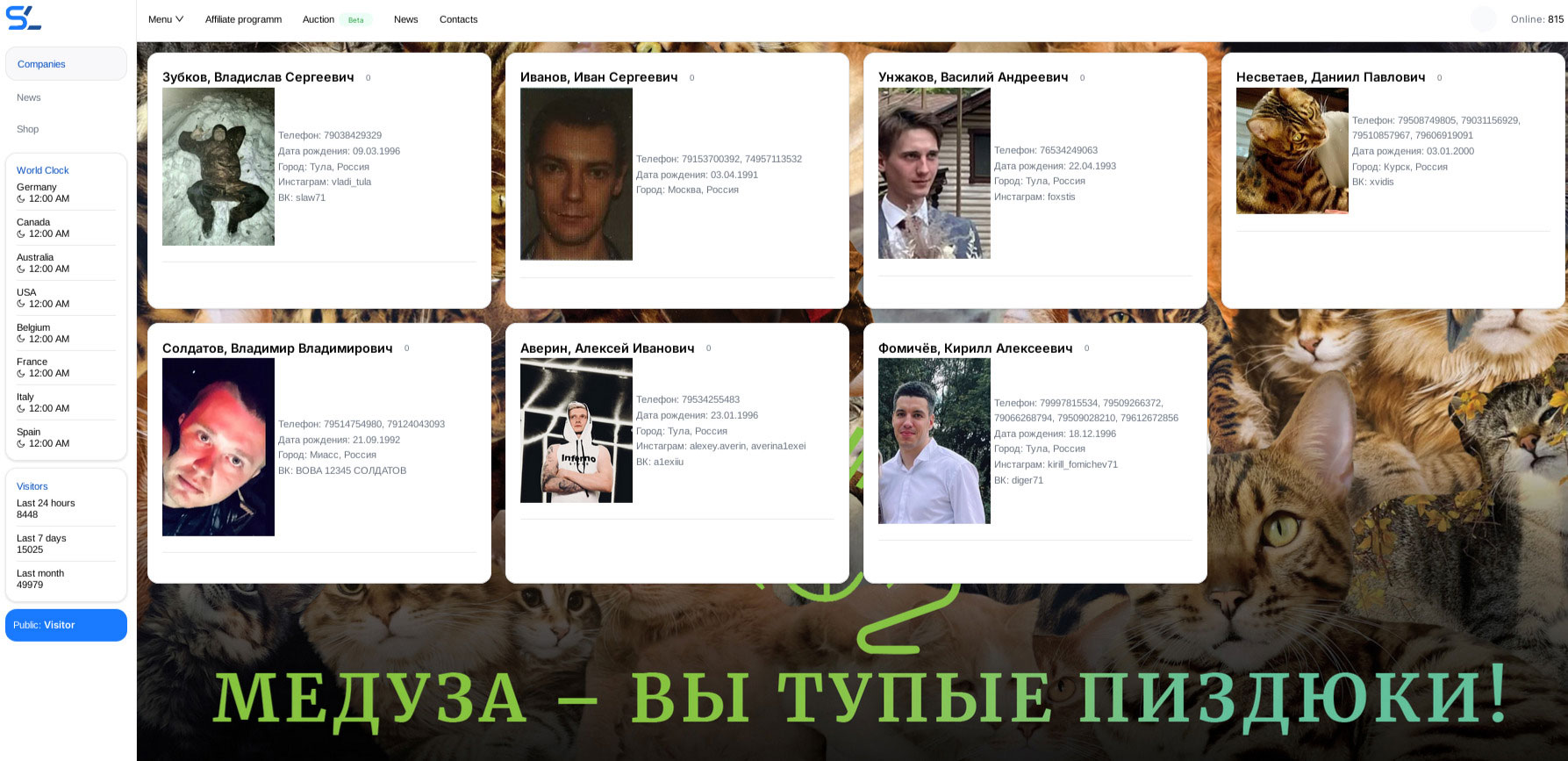
Meet the Silent data-extortion group—operators who've been allegedly active since March 2025, listing compromised entities on their Tor-based leak site through July. Then something beautiful happened: they got absolutely reverse-engineered by someone who decided their identities needed a public debut. Their Tor site now displays what appears to be the real identities of possible Silent gang members, complete with Russian names, cities, birthdates, phone numbers, and social media handles (VK, Instagram).
But here's the chef's kiss: the background is plastered with random cat photos, including one wearing what appears to be gear, with text underneath declaring "Медуза - вы тупые пизд*ки!” (Medusa - you are stupid f***ers!). The site navigation is completely broken—only the doxxing front page works, like someone rage-quit halfway through their revenge project.
The prevailing theory? Either a disgruntled Silent affiliate decided to burn bridges by exposing their Medusa ransomware connections, or someone hacked Silent specifically to reveal they're Medusa affiliates and gift-wrapped the intelligence for law enforcement. When your data-extortion operation gets counter-extorted so hard that your leak site becomes YOUR leak, you've achieved a cat-astrophic level of operational security failure that deserves its own case study.
🎯 The "Catching one specific idiot" request
Actor Bufo1 on BHF forum posted a heartfelt plea: "Парни кто пользуется, кто может сделать файл для поимки одного мудака:?" (Guys who use this, who can make a file to catch one specific a**hole?). This person wants custom malware development services to target one individual. The sheer pettiness of commissioning bespoke stealer malware for personal beef is extraordinary. This isn't nation-state espionage or organized crime—this is someone so annoyed at "one specific a**hole" they're shopping for targeted cyber-weapons on underground forums.
The threat landscape now includes personal vendettas requiring custom-built information stealers. Forget advanced persistent threats; we're now tracking advanced petty threats, where individuals with grudges can commission malware like they're ordering a custom birthday cake, except the cake steals your browser cookies and crypto wallets.
💰 Rhadamanthys developer's self-own: stealing from thieves
In a twist that would make Robin Hood file for early retirement, the developer behind Rhadamanthys stealer was caught red-handed stealing from their own criminal customer base. The "thief who robbed thieves" meta-theft was discovered when customers noticed their ill-gotten gains mysteriously vanishing before they could launder them properly.
The developer's response? A half-hearted "don't play with your luck" warning that somehow managed to be both a threat and a backhanded compliment to the victims' investigative skills. This represents perhaps the purest distillation of honor-among-thieves economics: there isn't any. One imagines Europol sending a thank-you card to the developer for doing their job for them, dismantling the operation from within through sheer greed. The underground's trust economy just became even more fictional than it already was.

🎁 The Mars Stealer fan club: free samples that sample you
Mars Stealer source code is being distributed like free samples at Costco, except instead of mini hot dogs, it's Russian stealer malware backdoored six ways to Sunday. Threat actors are downloading "free" source code with the enthusiasm of bargain hunters at a clearance sale, apparently unaware that the real product being sampled is their own operation. This is the cybercrime equivalent of accepting candy from strangers, except the strangers are other criminals and the candy is pre-poisoned. The underground has discovered the joy of open-source software, but forgot the part about reviewing the code before running it. Somewhere, the original Mars Stealer developer is collecting access to more criminal infrastructure than law enforcement, one free download at a time.

📚 The Malware analysis PhD dissertation
Actor SecuredCrypter on XSS posted a comprehensive 5,000-word malware analysis guide that reads like a PhD dissertation, complete with sandbox recommendations, dnSpy tutorials, and RunPE detection methods. The beautiful irony? This detailed "how to detect malware" guide is posted on a forum literally dedicated to creating and distributing malware. It's like a burglar writing a home security manual—technically helpful, but the motivation is suspect.
The threat intelligence takeaway is that even malware developers want to avoid getting infected by their competitors' garbage code, creating this bizarre ecosystem where criminals are simultaneously the most paranoid and most informed cybersecurity researchers on the planet. The guide includes practical advice about avoiding VM detection, analyzing .NET assemblies, and identifying crypter techniques—all skills that would make someone an excellent security analyst if they weren't using them to avoid getting scammed by other scammers.
💰 Duke's 500K USDT daily fast food service: money laundering at scale
Actor Gail Johnson (definitely a real name) is advertising for dukeman888888, who "urgently needs 500K USDT daily right now" with "fast payment within 10 minutes". The post lists every possible Indian corporate banking account type with MQR/Payin capabilities and promises "₹1 Cr+ Daily Payouts". This is money laundering infrastructure operating at cryptocurrency exchange scale, and they're advertising it openly on Telegram stock market channels.
The audacity of running a multimillion-dollar daily crypto laundering operation while posting contact info, including a WhatsApp number (+62 Indonesian prefix), is genuinely impressive. These operations are the backbone of ransomware payment processing and large-scale fraud cashout schemes, but apparently operational security takes a backseat to customer acquisition. When your money laundering service promises faster turnaround than a McDonald's drive-through, you've either perfected the craft or you're about to get arrested.
Conclusion
November 2025 proved once again that the underground threat landscape operates on a delicate balance of paranoia and incompetence, where criminals are simultaneously the most sophisticated and most hilariously inept actors on the digital stage. The month’s masterclass in circular criminal logic culminated in the Silent group's cat-meme-fueled downfall, the Mars Stealer community accepting backdoored "free samples" that sampled them right back, and the profound irony of the SecuredCrypter posting a 5,000-word malware analysis guide on a forum dedicated to distributing malware—presumably just to avoid getting scammed by his peers.
The real threat isn't necessarily the sophistication of these operations, it's the sheer volume of people willing to publicly document their multimillion-dollar crimes while complaining about mixer quality and subscription models. If this is the future of cybercrime, perhaps the best defense is simply stepping back and letting them continue talking themselves into an arrest.
Disclaimer
While these incidents are genuinely amusing, they represent real criminal activities causing significant harm. This content is for threat intelligence and educational purposes only.

Discover the latest cybersecurity research from the Trellix Advanced Research Center: https://www.trellix.com/advanced-research-center/
RECENT NEWS
-
Mar 02, 2026
Trellix strengthens executive leadership team to accelerate cyber resilience vision
-
Feb 10, 2026
Trellix SecondSight actionable threat hunting strengthens cyber resilience
-
Dec 16, 2025
Trellix NDR Strengthens OT-IT Security Convergence
-
Dec 11, 2025
Trellix Finds 97% of CISOs Agree Hybrid Infrastructure Provides Greater Resilience
-
Oct 29, 2025
Trellix Announces No-Code Security Workflows for Faster Investigation and Response
RECENT STORIES
Latest from our newsroom
Get the latest
Stay up to date with the latest cybersecurity trends, best practices, security vulnerabilities, and so much more.
Zero spam. Unsubscribe at any time.