
Blogs
The latest cybersecurity trends, best practices, security vulnerabilities, and more

Why Attackers Hope You Ditch Your On-Premises EDR
By Sanjay Raja · February 3, 2026
Vendors are pushing "cloud-native" as the solution to everything, and some vendors are now actively sunsetting their on-premises solutions. This aggressive push, exemplified by SentinelOne's recent End-of-Life (EOL) announcement for their hybrid solution offering, is leading customers to scramble to close new security gaps that have suddenly emerged in their infrastructure.
While cloud adoption is high, the vast majority of organizations still maintain on-premises assets like local file servers, legacy databases, and specialized workstations. If an organization uses a "cloud-only" EDR but has a large portion of its data sitting on local servers, they often face latency issues or "blind spots" if the connection between the local office and the cloud console is throttled or interrupted.
In addition, many mission-critical applications run on older versions of Windows or Linux that may not play well with modern, "heavy" cloud-native agents. On-premises EDR solutions are often better optimized for these local, long-standing environments. This is critical as threat actors often look to compromise systems that lack security protection and detection due to older and/or unsupported operating systems, where many vendors do not attempt to maintain coverage, though necessary.
For certain organizations, segregated (“air-gapped”) and operational technology (OT) networks, need to provide security for on-premises IT systems, where these environments serve as a critical jumping-off point for attackers to gain access to highly restricted and/or regulated data or disrupt industrial controls and physical processes.
Let's be honest: On-premises EDR is hard
First, let's acknowledge the truth. Running an EDR (Endpoint Detection and Response) platform on-premises is difficult, but it also contributes to more cost and complexity due to the following:
- Server and storage costs: Servers for data collection, processing, and long-term storage.
- Constant maintenance: You are responsible for patching, scaling, and database tuning.
- Resource constraints: It demands skilled in-house staff to manage and operate it effectively.
It is no surprise that security teams are tempted to offload this entire burden to a SaaS vendor. But security isn't about what's easy. It's about what's effective. Ditching your on-prem visibility because it's hard is like turning off the security cameras in your bank vault because the subscription fee is due.
Areas of concern where supporting on-premises EDR is essential
It is a common misconception that the world has moved entirely to the cloud. In reality, most modern enterprises operate in a hybrid reality—maintaining significant physical infrastructure while simultaneously leveraging cloud services.
Supporting on-premises EDR is vital not just for niche security cases, but because it aligns with the actual physical footprint of today’s businesses. Here is why EDR must bridge the gap between both worlds.
Air-gapped and isolated environments
Many high-security sectors use "air-gapped" networks—systems physically disconnected from the internet to prevent remote hacking.
- Critical infrastructure: Power plants and water treatment facilities cannot risk a cloud connection.
- Defense & intelligence: Military networks require the EDR console to live within their own secure perimeters.
- Manufacturing (ICS/SCADA): Factory floors often use local EDR to monitor for "insider threats" (like a rogue USB) without ever exposing the assembly line to the public web.
Data sovereignty and compliance
For many, the decision isn't about technology, but legality.
- Jurisdictional control: Some countries require that sensitive security telemetry (which includes usernames and file paths) never leaves national borders.
- Privacy mandates: In healthcare or banking, "Multi-tenant" cloud environments can be a compliance hurdle. On-premises EDR ensures the organization maintains 100% custody of its data, satisfying strict auditors and GDPR/HIPAA requirements.
Operational resilience & control
If an organization's ISP goes down or the cloud provider suffers an outage, a SaaS-based EDR console becomes a "black box." By supporting on-premises deployments, companies ensure that their security operations center (SOC) stays functional as long as their internal power is on. This "always-on" visibility is the backbone of a resilient security posture.
Conclusion
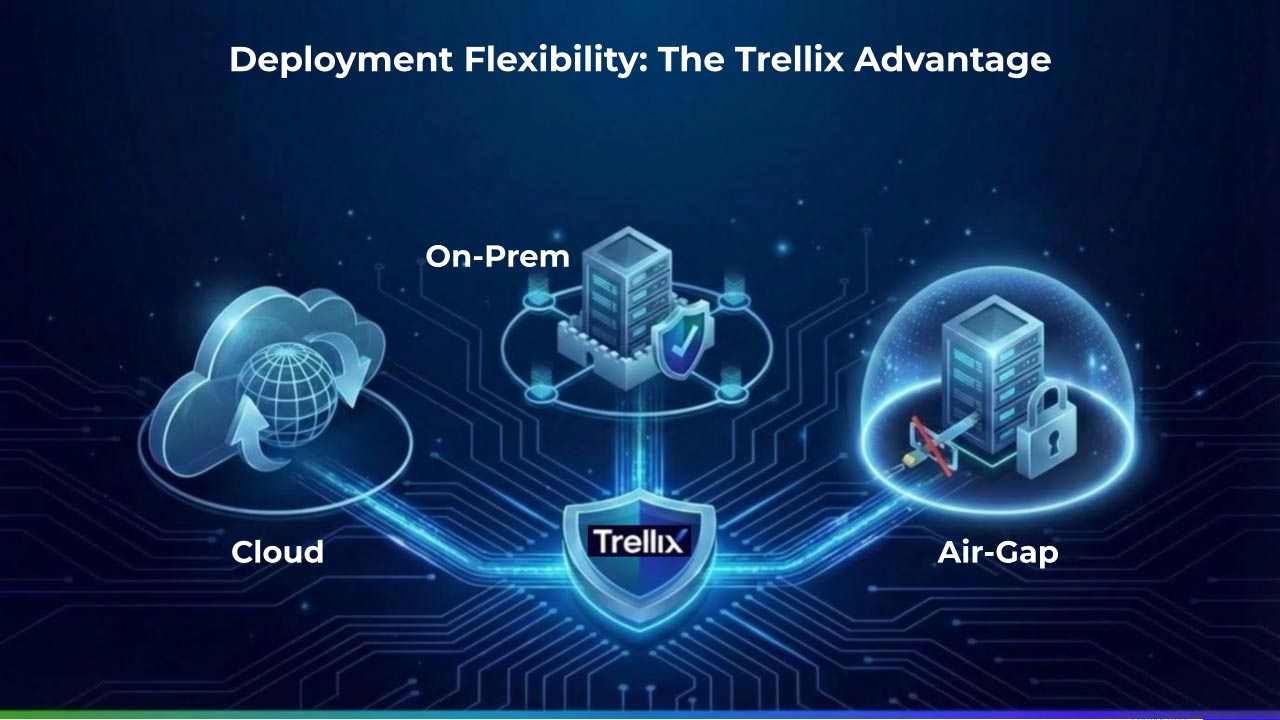
In conclusion, while the industry trend toward SaaS continues and vendors continue to drop or stop innovation on their on-premises endpoint security, the "hybrid reality" of modern enterprise requires an EDR solution that is as capable on-premises as it is in the cloud. Most organizations still rely on significant physical assets, legacy systems, and air-gapped segments where cloud-only protection simply cannot reach. By supporting on-premises deployments, vendors like Trellix provide the essential bridge for these environments, offering the data sovereignty and operational resilience needed to protect local infrastructure without an internet dependency. Ultimately, a truly robust security posture doesn't force a choice between cloud and local; it provides a unified defense that secures every asset, whether it sits in a remote data center or on a server rack just down the hall.
To try Trellix EDR for yourself, just request it here: https://www.trellix.com/request-demo/
RECENT NEWS
-
Apr 08, 2026
Trellix prevents enterprise data exposure in sanctioned and shadow AI
-
Mar 02, 2026
Trellix strengthens executive leadership team to accelerate cyber resilience vision
-
Feb 10, 2026
Trellix SecondSight actionable threat hunting strengthens cyber resilience
-
Dec 16, 2025
Trellix NDR Strengthens OT-IT Security Convergence
-
Dec 11, 2025
Trellix Finds 97% of CISOs Agree Hybrid Infrastructure Provides Greater Resilience
RECENT STORIES
Latest from our newsroom
Get the latest
Stay up to date with the latest cybersecurity trends, best practices, security vulnerabilities, and so much more.
Zero spam. Unsubscribe at any time.