
Trellix Advanced Research Center
The
Cyberthreat
report
The
Cyberthreat
report
November 2026
Insights gleaned from a global network of experts, sensors, telemetry, and intelligence
October 1, 2025 – March 31, 2026

The CyberThreat Report
Authored by the Trellix Advanced Research Center, this report (1) highlights insights, intelligence, and guidance gleaned from multiple sources of critical data on cybersecurity threats and (2) develops expert, rational, and reasonable interpretations of this data to inform and enable best practices in cyber defense. This edition focuses on data and insights captured primarily between April 1, 2026, and September 30, 2026.
The past six months have seen a fundamental structural shift in the global threat landscape. Modern security leaders can no longer evaluate cyber risk through the lens of isolated breach events or localized threat actor campaigns. Instead, the current environment is defined by the convergence of nation-state intelligence tradecraft, market-driven cybercriminal operational efficiency, and machine-speed autonomous execution. Maintaining business continuity requires converting strategic threat intelligence into machine-speed containment, continuous architectural hardening, and disciplined exposure management.
The report covers:
A look into the evolving APT landscape
Ransomware: A crowded market with fragmented power
AI in the underground: The emergence of agentic malware
The unseen credential surface: How AI agents expose secrets
Exploiting the known: Entrenched vulnerabilities, heavily targeted frameworks, and an emerging AI frontier
Read the Executive Summary for a high-level overview and key takeaways.
Read the Executive SummaryPreface
The six months from April through September 2026 mark a period in which tempo and autonomy became the defining qualities of adversary behavior. Tradecraft remained constant—trusted tools, known vulnerabilities, blended espionage and financial motivation—but the speed at which these forces operate, and the degree to which human direction is no longer a prerequisite for capability, did not. Ransomware groups and victim posts both reached record numbers, with newcomers accounting for nearly a third of all posts by August. The fragmentation is structural: power is distributed across a wider field of operators, each moving faster and requiring less infrastructure than before.
AI is the clearest accelerant, and this period marks a step-change from assistance to delegation. Underground markets now offer autonomous agents that plan and execute full intrusions with minimal human oversight. In practice, we observed TITAN AI using NLP pipelines to parse stolen documents and auto-draft multi-agency extortion packages at machine speed, and an LLM-based agent completing an entire attack chain before deploying ransomware designed to destroy AI models and training data. AI also exposes a new defensive liability security teams have not yet fully priced in: the credential surface. AI agents routinely move secrets out of encrypted stores and onto command lines, into local files, and into external model context windows. The exposure is accidental but systemic, and demands an architectural response. At the Trellix Advanced Research Center, we expect AI adoption to become nearly universal among capable threat actors, with AI increasingly embedded across different stages of the attack lifecycle. The question is no longer whether adversaries will use AI, but how extensively they will integrate it into their operations, and how quickly defenders can adapt.
The April 2026 introduction of Anthropic's Claude Mythos Preview marked another significant inflection point. Its demonstrated ability to autonomously discover previously unknown vulnerabilities and develop working exploits signals a fundamental shift in the speed and economics of vulnerability research. While these capabilities are currently being directed toward defensive research under controlled access, their broader implications are clear. We should expect an acceleration in vulnerability discovery and, as comparable capabilities become more accessible, increasingly compressed timelines between discovery, weaponization, and exploitation. For defenders, this introduces a growing challenge: the ability to discover vulnerabilities may soon outpace the industry's capacity to validate, prioritize, and remediate them.
Geopolitical instability continued to shape nation-state activity in concrete, measurable ways. Iran-aligned detections surged in July, coinciding with renewed US–Iran military hostilities, consistent with our longstanding assessment that cyber operations intensify during regional escalation as asymmetric pressure short of direct military engagement. Russia continued to combine military operations in Ukraine with gray-zone tactics across NATO's eastern flank, complicating attribution and testing alliance cohesion. China-aligned detections declined across the period: a shift in operational focus, we assess, rather than reduced intent, and one that warrants vigilance rather than reassurance.
The operational discipline this period demands is proportion and correlation. The flaws driving the heaviest exploits are not zero-days, but disclosed, cataloged, and patchable. Ransomware group names change every six months; their techniques change far less. And the autonomous agents, credential exposures, and agentic malware that define this period share a common defensive requirement: the unit of analysis must be the full sequence attributed back to the originating process, not the individual event.
For organizations, maintaining resilience in this environment requires converting strategic threat intelligence into action across four priorities.
Anchor remediation to evidence of exploitation rather than to disclosure volume, which now runs into the tens of thousands of CVEs per reporting period.
Treat every endpoint running an AI agent as high-value, credential-handling infrastructure, enforce short-lived tokens, and correlate agent activity across the full process chain rather than at the event level.
Bring AI orchestration tools, low-code builders, and Model Context Protocol servers into vulnerability management scope now, ahead of the exploitation wave our external sources confirm is already building.
Meet machine-speed attacks with machine-speed defense.
AI-powered detection and automated response are no longer a capability advantage; they are the baseline required to operate at the tempo adversaries have already reached. The security programs best positioned are those using AI to shift from a reactive stance to readiness—building cyber resilience for the AI era.

VP, Threat Intelligence Strategy, Trellix
Introduction
Geopolitical Escalation and Strategic Competition Shape State-aligned Cyber Threat Activity
From April through September 2026, China, Iran, and Russia continued to use cyber capabilities to support their broader geopolitical and security objectives, although their activities and strategic priorities differed. China-aligned activity remained elevated amid continued military and maritime pressure around Taiwan, while Iran-aligned detections surged in July during renewed US–Iran hostilities. Russia continued to combine cyber operations with its war against Ukraine and broader pressure on European security. Across all three countries, cyber operations provide opportunities for intelligence collection, disruption, and strategic pressure alongside conventional military and gray-zone activities. However, changes in detection levels do not necessarily reflect changes in operational intent, and the available data does not establish a direct link between geopolitical developments and specific cyber activity. These trends highlight the importance of assessing cyber detections alongside military activity and broader geopolitical developments to better understand evolving threats and strategic priorities.
Russia: Cyber Operations and Gray-Zone Tactics to Pressure Ukraine and NATO
From April through September 2026, Russia continued to pose a security challenge through its war against Ukraine, cyber operations, and pressure on European security. Russian missile and drone strikes continued to threaten Ukrainian infrastructure, with energy systems facing additional pressure as winter approached. In April, US agencies also warned that Russian military intelligence actors were exploiting vulnerable routers to steal sensitive information. These developments highlight how Russia continues to use both military and cyber capabilities to support its strategic objectives.
Beyond Ukraine, Russia may use gray-zone tactics, including cyber operations, suspected sabotage, and infrastructure disruption, to pressure European countries without triggering direct military confrontation. Reported incidents involving suspected sabotage and drone incursions around Poland and the Baltic states have raised concerns about regional security, infrastructure resilience, and NATO readiness. However, the available information does not confirm that Russia directed all these incidents or that they were part of a coordinated campaign.
We assess with moderate confidence that Russia will continue to use cyber operations and other gray-zone tactics to test defensive capabilities, challenge US and NATO resolve, and impose costs while limiting the risk of direct military escalation. These activities could create uncertainty, complicate attribution, and put additional pressure on alliance cohesion. They may also complement Russia’s military campaign in Ukraine by increasing pressure on countries supporting Kyiv.
Russia remains difficult to predict, particularly in how it responds to Western countermeasures and how much risk it is willing to accept. Although gray-zone tactics give Moscow options for applying pressure below the threshold of open conflict, miscalculation or a shift in its willingness to accept risk could lead to unintended escalation.
In sum, the main concern for the United States and its allies is not limited to individual cyberattacks or suspected sabotage incidents. The cumulative effects of these activities could weaken infrastructure resilience, complicate deterrence, and test NATO cohesion, particularly as Russia continues its war against Ukraine and seeks to pressure countries supporting Kyiv.
Iran: Regional Escalation Coincides with a Surge in Cyber Threat Detections
Trellix global telemetry recorded a sharp increase in Iran-aligned threat activity in July 2026, with detections rising approximately 84% from June to a yearly peak of 145K, as shown in the following figure. This increase coincided with renewed escalation in the US–Iran conflict. Military hostilities resumed on July 7 following the breakdown of a June ceasefire arrangement. Throughout July, US forces struck Iranian military and maritime capabilities, while Iran retaliated amid rising tensions over the Strait of Hormuz.
Explore our threat detections with the interactive Trellix Threat Map
See the MapIran-aligned Detections (Jan 2026 – Sep 2026)
This escalation provides important context for the increase in cyber detections during the reporting period. Iran may use cyber operations alongside conventional military activity to collect intelligence, disrupt adversaries, and apply pressure without relying solely on direct military engagement. However, the timing of the increase does not confirm that the conflict caused the surge or that the activity was part of a coordinated retaliation.
Critical infrastructure and operational technology remain key areas of concern. During the reporting period, US government advisories highlighted Iranian-affiliated actors targeting internet-connected programmable logic controllers (PLCs). Access to these systems could expose industrial processes to disruption across sectors such as energy, manufacturing, and water. During a period of heightened tensions, this access could provide Iran with additional ways to pressure adversaries and create operational uncertainty without direct military engagement.
Iran-linked cyber operations also support intelligence collection and surveillance. Reported spyware activity targeting dissidents, activists, and journalists shows how these capabilities can be used to monitor perceived opponents, access sensitive communications, and extend surveillance beyond the battlefield.
In sum, cyber operations provide Iran with a way to advance its geopolitical objectives through intelligence collection, disruption, surveillance, and potential retaliation. As regional tensions rise, these capabilities may become more strategically significant, even when links between specific cyber incidents and geopolitical events remain unconfirmed. The July detection peak and subsequent rebound in September warrant continued monitoring to assess whether changes in cyber activity reflect evolving operational priorities as the regional situation develops. For the latest Iran-related threat detections, visit Trellix’s Iran Threat Map.
China: Cyber Detection Trends Track Shifts in Military and Maritime Pressure Around Taiwan
China-aligned detections declined 41.4% between April and September 2026, although activity fluctuated throughout the reporting period. As shown in the following figure, detection levels remained elevated in March and April 2026. Detections increased to approximately 240k in July before falling again in August and September, reaching approximately 190K. Despite this decline, China-aligned detections remained substantially higher than Iran- and Russia-aligned activity, indicating that China-related cyber activity remained significant throughout the reporting period.
The detection trend broadly coincided with changes in Chinese military and maritime activity around Taiwan. Chinese military aircraft activity declined during the first quarter of 2026 before increasing in April, around the same time cyber detections rose. Beginning in June, China expanded coast guard-led gray-zone operations around Taiwan, including more persistent maritime activity east of the island. Cyber detections also increased slightly from June to July 2026. Military and maritime pressure continued through September and October, with sporadic spikes in activity, even as overall cyber detection volumes remained below earlier levels.
China-aligned Detections (Jan 2026 – Sep 2026)
The broader geopolitical context suggests a potential correlation between China-aligned cyber activity, Beijing’s pressure on Taiwan, and its wider strategic objectives. However, the available data does not establish a causal relationship. Changes in detection volumes may reflect shifts in targeting priorities, intelligence collection requirements, infrastructure, or detection visibility rather than changes in the level of operational activity.
Other geopolitical developments may also influence China’s intelligence priorities. The Russia–Ukraine war and the US–Israel–Iran conflict provide opportunities for Beijing to observe Western military capabilities, battlefield technologies, sanctions enforcement, and the use of cyber operations alongside conventional warfare. These conflicts may inform Chinese intelligence collection and military planning, although there is no direct evidence linking them to the decline in China-aligned detections during this period.
In sum, the decline in China-aligned detections should not be viewed in isolation from broader geopolitical developments. Despite the drop in detections, China continued military and maritime operations around Taiwan, while conflicts in other regions may offer Beijing opportunities to observe Western military capabilities and how cyber operations are used alongside conventional warfare. However, there is not enough evidence to link these developments directly to the changes in cyber detections. The decline may reflect changes in targeting, infrastructure, or detection visibility rather than a reduction in activity. The key takeaway is that lower detection levels do not necessarily mean a lower threat, particularly as China-aligned activity remains higher than that of other nation-state actors.
Key Findings
A look into the evolving APT landscape
APT targeting is dominated by a two-nation axis: the United States and Türkiye jointly represent over three-quarters of all detections.
Transportation & shipping and telecom together absorb over half of all detected campaign volume, reflecting an intense focus on intelligence collection across logistics, global supply chains, and communications backbones.
The top 10 actors collectively represent 56% of all detections, pointing to a core group of highly active, well-resourced operators surrounded by a long tail of lower-volume actors.
Ransomware: A crowded market with fragmented power
The Gentlemen overtook Qilin as the most actively posting ransomware group, less than a year after it first appeared.
We observed the highest number of victim posts from active groups of any six-month period in our data. Additionally, 55 groups posted for the first time and accounted for 22% of all victim posts.
While overall victim posts in the United States fell from the previous six months as more groups targeted European victims, Trellix telemetry still recorded more unique ransomware campaigns in the US than in any other country.
AI in the underground: The emergence of agentic malware
AI has evolved from a drafting aid into an autonomous operator capable of scanning, exploiting, propagating, and executing entire intrusions with minimal or no human direction.
Underground marketplaces have split into two tiers: a saturated, low-cost tier of uncensored chatbots and jailbreak wrappers, and a smaller, far more expensive tier of autonomous agents which promises to plan and execute whole intrusions with minimal human oversight.
Ransomware operations like TITAN AI leverage dedicated NLP pipelines to rapidly parse stolen documents, calculate maximum regulatory liabilities across dozens of global frameworks, and automatically draft multi-agency disclosure packages to maximize pressure.
The unseen credential surface: How AI agents expose secrets
AI agents have become one of the enterprise's largest and least protected credential-handling layers—exposed by design.
Every exposure is living-off-the-land, so single-event detection fails.
No single event separates the agent from an attacker, so organizations need to correlate the full chain of credential access, use, and egress back to the agent process that started it.
Exploiting the known: Entrenched vulnerabilities, heavily targeted frameworks, and an emerging AI frontier
Legacy flaws on internet-facing infrastructure, not zero-days, drive the heaviest exploit-detection volume.
The application-framework flaw, React2Shell, shows heavy detection activity across all telemetry.
Within the reporting window, detection volume for most classic N-day exploit rules fell while a small set rose, a shift only period-over-period telemetry reveals.
The groundbreaking core of an agentic SOC
Explore Trellix WiseMethodology overview
Experts from our Trellix Advanced Research Center gather the statistics, trends, and insights comprising this report from a wide range of global sources, both captive and open. The aggregated data is fed into our Trellix Insights and ATLAS platforms. Leveraging AI, machine learning, automation, and human acuity via our research and Trellix SecondSight hunting, the team cycles through an intensive, integrated, and iterative set of processes—normalizing the data, analyzing the information, and developing insights meaningful to cybersecurity leaders and SecOps teams on the front lines of cybersecurity worldwide. For a more detailed description of our methodology, please see the end of this report.
Report analysis, insights, and data
- APT targeting is dominated by a two-nation axis: the United States and Türkiye jointly represent over three-quarters of all detections.
- Transportation, shipping, and telecom together absorb over half of all detected campaign volume, reflecting an intense focus on intelligence collection across logistics, global supply chains, and communications backbones.
- The top 10 actors collectively represent 56% of all detections, pointing to a core group of highly active, well-resourced operators surrounded by a long tail of lower-volume actors.
A look into the evolving APT landscape
Geographic distribution of activity
Advanced persistent threat (APT) targeting in this period is dominated by a two-nation axis: the United States and Türkiye jointly represent over three-quarters of all detections, dwarfing all other geographies combined.
This concentration suggests either outsized telemetry collection focus in these regions or genuinely disproportionate adversary interest—most plausibly a combination of large attack surface (US) and strategic/geopolitical targeting (Türkiye) by multiple nation-state clusters.
The remaining ~97 countries that recorded any detection share just 10.9% of total volume, each individually immaterial, which reinforces that APT resourcing is being funneled into a small number of high-value targets rather than spread broadly.
A quarter-over-quarter (QoQ) evaluation shows significant shifts in the geographic breakdown of observed APT threat activity. While Türkiye and the United States remained the primary focal points across both quarters, their relative positioning shifted: Türkiye led in Q2 at 36.80%, but the United States surpassed it in Q3, rising to 42.87% (up from 33.12% in Q2). Meanwhile, other regions saw turnover in the lower tiers of the top ten, with nations such as China, the Democratic Republic of the Congo, Qatar, and Israel appearing in the Q3 rankings.
Top 10 affected countries
Q2 2026 vs. Q3 2026 Geographic distribution of detections
The United States has the highest number of detections with 37.98%, likely driven by its status as the world’s largest economy and the concentration of high-value technology, defense, and government infrastructure
Türkiye has the second-highest detections with 37.15%, potentially reflecting the country’s strategic position at the intersection of Europe, the Middle East, and Central Asia
Germany received the third-most-targeted nation with 4.40% and the highest-exposure Western European country due to its broad strategic value as a NATO member, a major global economy, and a key technology hub
Analysis of the top three targeted countries
The United States accounts for the largest share of APT detections with 37.98% of the total global volume.
This concentration of activity is driven by the country's position as the world’s largest economy and the high concentration of technology, defense, and government infrastructure.
Türkiye has the next-highest number of detections at 37.15%, with the biggest increase in activity between Q2 2026 and Q3 2026.
This potentially reflects Türkiye’s strategic geopolitical position at the intersection of European, Middle Eastern, and Central Asian threat vectors.
Germany received the third-most detections, accounting for 4.40% of total global APT volume.
Germany’s actor mix reflects a broad, diversified set of state-linked clusters, with no single dominant group.
Business services: 1.90%
Technology: 1.36%
Education: 0.02%
Government: 0.01%
Telecom: 0.01%
The US threat landscape is characterized by a particular focus on business services and technology.
Transportation and shipping: 10.38%
Government: 5.08%
Finance: 0.17%
Telecom: 0.05%
Detections in Türkiye are heavily concentrated on critical sectors, with transportation and shipping and government accounting for the highest attributed volumes.
The lack of contextual information makes it difficult to draw meaningful conclusions.
Gamaredon Group: 19.88%
APT36: 13.33%
Lazarus: 5.68%
MuddyWater: 5.27%
Mustang Panda: 4.67%
While APT activity spans a diverse range of threat actors, the Russian-linked Gamaredon Group remains the primary driver, accounting for 19.88% of US detections. Other highly active groups include APT36, Lazarus, MuddyWater, and Mustang Panda.
MuddyWater's presence among the top five most active groups may be influenced by the ongoing conflict between the US and Iran.
Lazarus: 9.34%
Kimsuky: 7.36%
Mustang Panda: 5.75%
MuddyWater: 5.59%
APT36: 4.99%
The top five APT groups targeting Türkiye are led by North Korean-linked Lazarus (9.34% of detections) and Kimsuky (7.36%), followed by Mustang Panda, MuddyWater, and APT36.
Lazarus: 8.32%
Gamaredon Group: 7.86%
Mustang Panda: 5.07%
MuddyWater: 5.06%
Kimsuky: 4.57%
The threat profile for Germany includes multiple threat actors from different countries, such as North Korea (Lazarus and Kimsuky), Russia (Gamaredon), China (Mustang Panda, and Iran (MuddyWater).
Cmd: 55.25%
PowerShell: 51.36%
WMIC: 35.79%
curl: 28.73%
Telegram: 26.16%
Cmd: 47.10%
PowerShell: 46.98%
Schtasks.exe: 28.35%
Rundll32: 20.34%
Net: 19.52%
Cmd: 49.62%
PowerShell: 44.66%
Schtasks.exe: 26.13%
Net: 22.64%
WMIC: 22.63%
System Information Discovery (T1082): 82.45%
Web Protocols (T1071.001): 79.56%
File and Directory Discovery (T1083): 79.44%
Deobfuscate/Decode Files or Information (T1140): 79.38%
Ingress Tool Transfer (T1105): 77.95%
System Information Discovery (T1082): 78.77%
Web Protocols (T1071.001): 77.89%
Deobfuscate/Decode Files or Information (T1140): 72.87%
Ingress Tool Transfer (T1105): 69.63%
Malicious File (T1204.002): 66.84%
System Information Discovery (T1082): 77.69%
Web Protocols (T1071.001): 77.67%
Deobfuscate/Decode Files or Information (T1140): 76.46%
Ingress Tool Transfer (T1105): 70.01%
File and Directory Discovery (T1083): 67.95%
Sectoral impact
The sector-attributed data highlights a critical concentration of threat activity directed toward vital operational networks. Transportation and shipping and telecom together absorb over half of all detected campaign volume, reflecting an intense focus on intelligence collection across logistics, global supply chains, and communications backbones. Threats targeting these core infrastructures pose a systemic risk, as disruptions or compromise within these verticals can cascade into broader economic and operational impacts.
Furthermore, the persistent targeting of government, media and communications, and business services points to a multifaceted espionage strategy. Threat actors appear focused on obtaining strategic geopolitical insight, disrupting public communications, and exploiting third-party business services to facilitate downstream access to high-value targets.
Top 10 affected sectors
Threat actor analysis
No single actor dominates; the leading group (Gamaredon) accounts for just 9.03% of volume, yet the top 10 collectively represent 56% of all detections, pointing to a core group of highly active, well-resourced operators surrounded by a long tail of 287 lower-volume actors.
Nation-state clustering is evident: Russia-nexus (Gamaredon, APT29, APT28), Pakistan-nexus (APT36), China-nexus (Mustang Panda, APT40), North Korea-nexus (Lazarus, Kimsuky, Bluenoroff), and Iran-nexus (MuddyWater) groups all appear in the top 10, confirming simultaneous multi-origin targeting rather than a single dominant threat.
The threat actor landscape also underwent significant churn between quarters. In Q2 2026, activity was relatively distributed among top groups, led by APT40 (7.93%), Lazarus (7.68%), and MuddyWater (7.52%). By contrast, Q3 2026 saw a sharp concentration and surge in activity among specific actors, with the Russian-linked Gamaredon Group leaping to the top position at 10.72% (compared to 7.35% in Q2), closely followed by APT36 at 10.25% (up from 5.43%), and Mustang Panda rising to 8.78%. This highlights an intensification of focus by a core group of highly active state-sponsored operators heading into the second half of the year.
Top 10 APT threat actors for Q2 to Q3
Analysis of the most aggressive APT groups
Accounting for 9.03% of all observed activity, Gamaredon Group emerged as the single most active threat actor.
As a prolific Russian state-sponsored cyber espionage group, Gamaredon Group concentrates its operations primarily on military and political targets in Ukraine, while steadily expanding surveillance efforts against Western allies and NATO-aligned institutions.
Ranked second, APT36 accounted for 7.84% of total detections.
With a growing footprint across the global threat environment, the Pakistan-nexus threat actor primarily conducts cyber espionage operations. The group maintains a distinct focus on Southeast Asia alongside nations capable of shaping regional geopolitical dynamics.
Ranked third, Mustang Panda accounts for 7.52% of total recorded events.
A China-nexus cyber threat actor, Mustang Panda concentrates on worldwide espionage operations. The group is widely recognized for its extensive use of customized PlugX remote access trojan (RAT) variants and highly tailored phishing lures.
United States: 83.64%
Türkiye: 8.66%
Germany: 3.83%
China: 0.96%
Canada: 0.90%
Gamaredon Group's operational footprint was heavily focused on the United States, which accounted for 83.64% of its activity, with Türkiye adding an additional 8.66%. The group targets these nations primarily to collect intelligence regarding Western military assistance for Ukraine and broader NATO-aligned strategic initiatives.
United States: 64.54%
Türkiye: 23.63%
Canada: 4.53%
Germany: 1.85%
India: 1.44%
With over 88% of its operations focused on the United States and Türkiye, APT36's targeting pattern likely reflects intelligence collection on NATO allies and South Asian strategic affairs, including defense partnerships, military procurement, and diplomatic engagement.
Türkiye: 28.38%
United States: 23.58%
Vietnam: 18.94%
Democratic Republic of Congo: 4.70%
China: 4.25%
Mustang Panda concentrated nearly 52% of its operational volume on Türkiye and the United States, carrying out state-sponsored intelligence gathering on NATO military capabilities to support strategic Chinese interests.
Telecom: 0.95%
Transportation and shipping: 0.86%
Government: 0.38%
Technology: 0.18%
Finance: 0.04%
Telecom: 4.52%
Transportation and shipping: 2.90%
Government: 0.52%
Technology: 0.42%
Finance: 0.03%
Media and communications: 18.83%
Transportation & Shipping: 3.83%
Telecom: 2.50%
Government: 1.76%
Technology: 0.58%
Cmd: 97.26%
Pteranodon: 92.94%
UltraVNC: 92.83%
QuietSieve: 92.56%
Taskkill: 92.36%
Gamaredon Group strongly relies on LOLBins and custom malware, such as Pteranodon or QuietSieve, during its operations.
Poseidon Agent: 67.66%
GlobShell: 67.17%
PyShellFox: 65.03%
python.exe: 63.65%
PowerShell: 60.26%
Custom malware forms the backbone of most APT36 operations, with Poseidon Agent, GlobShell, and PyShellFox being the most prominent tools in their arsenal.
PlugX: 52.34%
Cmd: 46.33%
Schtasks.exe: 43.42%
Reg: 31.72%
Rundll32: 31.62%
The group's signature tool PlugX dominates usage, indicating standardized operational procedures.
Web Protocols (T1071.001): 99.72%
Visual Basic (T1059.005): 99.42%
Spearphishing Attachment (T1566.001): 98.81%
Malicious File (T1204.002): 98.79%
Deobfuscate/Decode Files or Information (T1140): 98.77%
Malicious File (T1204.002): 99.42%
File and Directory Discovery (T1083): 98.38%
System Information Discovery (T1082): 98.28%
Ingress Tool Transfer (T1105): 97.02%
Spearphishing Attachment (T1566.001): 96.12%
DLL Side-Loading (T1574.002): 94.96%
Deobfuscate/Decode Files or Information (T1140): 83.90%
Web Protocols (T1071.001): 82.40%
Registry Run Keys / Startup Folder (T1547.001): 80.93%
Ingress Tool Transfer (T1105): 76.57%
Tools and techniques
The tool landscape is bifurcated: a handful of dual-use OS utilities (PowerShell, Cmd, WMIC, Net) appear in roughly a fifth to a half of all detections, operating alongside well-known offensive frameworks (Cobalt Strike, Mimikatz) used for lateral movement and credential theft.
At the technique level, discovery and C2/exfiltration tradecraft (System Information Discovery, Web Protocols, Ingress Tool Transfer) dominate with 70%–81% prevalence, confirming that reconnaissance and tool-staging are near-universal behaviors across the APT population tracked.
Top 10 APT tools
Top 10 tool types
Top tools used
Backdoor
20.9%
Dominated by backdoor deployment, this heavy reliance indicates that persistent threat actors prioritize durable, long-term access over swift exploitation, aligning with their overarching, extended intelligence-gathering objectives.
Infostealer
11.87%
Ranking second among observed tool types, info stealers underscore persistent threat groups' ongoing reliance on deliberate data harvesting.
Loader
9.5%
Loaders ranked as the third most prevalent tool category, underscoring their critical role in delivering secondary, more advanced malware payloads to fulfill threat actors' overarching objectives.
Top 10 tool names
Top 10 MITRE techniques
Implications and recommendations
The evolving APT landscape demonstrates a heavily concentrated focus by nation-state actors on critical infrastructure, particularly within the transportation, shipping, telecommunications, and government sectors. The dominance of a two-nation axis involving the United States and Türkiye, alongside a diverse cohort of threat groups such as Gamaredon, APT36, and Mustang Panda, underscores a systemic risk where espionage operations target vital operational networks and communications backbones. Because these campaigns prioritize stealth, long-term persistence, and intelligence collection over immediate disruption, organizations face heightened exposure to sophisticated, multi-origin threats that leverage dual-use administrative tools alongside custom backdoors and info stealers.
To mitigate these risks, organizations must adopt a proactive defense strategy focused on deep visibility and behavioral monitoring rather than relying solely on signature-based detection. Security teams should closely monitor the execution and abuse of native operating system utilities such as PowerShell, command-line interfaces, and Windows Management Instrumentation, which threat actors often co-opt to blend in with normal network traffic. Furthermore, strengthening defenses around critical infrastructure verticals, specifically supply chain nodes, telecommunications, and government interfaces, is essential for disrupting reconnaissance and preventing prolonged, unauthorized access by persistent state-sponsored operators.
Building a robust security posture requires shifting from traditional, signature-centric alerts to context-aware, behavioral detection strategies. Key priorities include establishing thorough activity baselines, enforcing strict least-privilege access controls, and establishing clear administrative domain segmentation. Organizations must prioritize ongoing threat hunting to identify abuse of native tools, such as PsExec, WMI, and PowerShell, alongside rigorous auditing of privileged accounts. Seamless alignment among threat intelligence, IT, and SOC teams is essential to spot subtle indicators of compromise, including unauthorized lateral movement via valid credentials or abnormal command-line executions.
Ransomware: A crowded market with fragmented power
- The Gentlemen overtook Qilin as the most active ransomware group, less than a year after it first appeared.
- We observed the highest number of victim posts from active groups of any six-month period in our data. Additionally, 55 groups posted for the first time and accounted for 22% of all victim posts.
- While overall victim posts in the United States fell from the previous six months as more groups targeted European victims, Trellix telemetry still recorded more unique ransomware campaigns in the US than in any other country.
For this report, the following section looks at three sets of data:
Victim posts: Public posts from groups sharing the details of their victims
Trellix telemetry: Data from the Trellix ATLAS campaign and detection data set
Ecosystem context: Trellix monitoring of cybercriminal forums
Leak sites published 5,505 victim posts between April and September 2026. That is about the same as the previous six months and 67% more than the same period last year. What did grow was the number of groups: 124 groups posted victims, the most we have recorded, and 55 of them posted for the first time. By August and September, about a third of all victim posts came from groups that did not exist in our data six months earlier.
At the top, the order changed. The Gentlemen, a RaaS operation that posted only 38 victims in the same period last year, published 719 and overtook Qilin, the most active group in each of the previous two six-month periods. LockBit came back as LockBit 5.0 and finished third. Cl0p returned to mass data theft through another zero-day software exploitation.
Trellix telemetry points in the same direction. We recorded 2.2M+ ransomware-related detections across 775 unique ransomware campaigns, up 4.7%. Fewer detections spread across more campaigns is what a fragmented market looks like from the defender's side.
The pressure on these groups came from two directions. Law enforcement kept up a steady pace of takedowns, sanctions, and sentencings, aimed less at the brands themselves and more at the services they depend on: VPNs, crypto laundering, bulletproof hosting, and malware loaders. The gangs also turned on each other. In September, ShinyHunters hacked and defaced Cl0p's own leak site and threatened to extort the extortionists.
Ransomware group activity
The Gentlemen and Qilin are well ahead of everyone else. Below them, the field is wider than ever: no other group reached even 5% of all victim posts. The top five groups accounted for 37.3% of posts, down from 42.1% in the previous six months and 39.8% a year earlier. Akira, a top-five group in each of the previous three six-month periods, slipped to sixth.
Groups with most victim posts
Victim posts by month, all groups
Unlike the previous two summers, when monthly volume stayed roughly flat from June to August, activity in 2026 dipped in June and then climbed to a peak of 1,214 posts in August, when a record 72 groups posted victims.
The Gentlemen: From newcomer to number one
The Gentlemen first appeared on leak sites in September 2025. A year ago, it had posted 38 victims; in the previous six months, 209. Between April and September 2026, it posted 719, more than triple its previous total.
The Gentlemen and Qilin victim posts by month
Only 28% of its geo-identified victims were in the United States, compared with 43% for Qilin, with the UK, France, Italy, Germany, and India making up much of the rest. It was the most active group against manufacturing, healthcare, information, and education organizations, and it alone accounted for a quarter of all wholesale trade victims.
Public research explains how it scaled so quickly. Microsoft, which tracks the group as Storm-2697, published an analysis in May of its self-propagating Go encryptor. Check Point found affiliates using the SystemBC proxy malware and lockers for Windows, Linux, NAS, BSD, and ESXi. Affiliates get in through compromised FortiGate devices, including through the Fortinet authentication bypass CVE-2024-55591, and the group gives them GentleKiller, a suite of tools that abuse vulnerable drivers to shut down endpoint security from dozens of vendors. The Gentlemen also topped our Trellix ATLAS campaign data, with more ransomware campaign reports than any other group during the period.
Qilin: Still a heavyweight
Qilin posted at least 75 victims every month of the period and led The Gentlemen in April and May. Its total of 655 is 22% lower than the previous half but 48% higher than a year ago. Its targeting is broad and consistent: manufacturing (19% of its posts), professional services (18%), and construction (10%). Qilin affiliates were among the fastest to use new edge-device vulnerabilities, with public reporting linking the group to a Check Point Remote Access VPN zero-day in June and a Palo Alto Networks GlobalProtect authentication bypass in July. In August, Qilin listed the US Bureau of Alcohol, Tobacco, Firearms and Explosives (ATF) on its leak site; ATF confirmed a "major incident" on a standalone system the same day.
LockBit 5.0: The comeback
In our April 2025 report, LockBit3 had fallen out of the top 20. A year and a half later, LockBit is back in third place. LockBit 5.0 posted 248 victims during the period, up from 119 in the previous six months and 21 a year ago. Only 24% of its geo-identified victims were in the US. The US charged the operators of the Media Land bulletproof hosting service in July, which prosecutors say supported LockBit, BlackSuit, and Play.
Cl0p: Same playbook, new target
Cl0p posted just two victims between April and July. In August and September, it published 116, and 100 of those appeared in just three days. The pattern will be familiar to anyone who followed its MOVEit, GoAnywhere, and Cleo campaigns. This time the target was PTC Windchill and FlexPLM, product lifecycle management software used heavily by manufacturers. Cl0p exploited CVE-2026-12569, an unauthenticated remote code execution flaw, to install web shells and steal data, and by mid-August it had named more than 40 victims. It didn't encrypt anything; the attack was about stealing data. A month later, ShinyHunters broke into Cl0p's leak site through a flaw in its Grav CMS installation, defaced it, claimed to have stolen source code and keys, and demanded an eight-figure payment from Cl0p itself.
A record number of newcomers
Between April and September, 55 groups posted their first victims, accounting for 1,213 victim posts (22% of the total). Their share grew from 8% of posts in April to about 35% in August and September. Some are rebrands or former affiliates going independent, and many publish a large backlog on their first day, but starting a ransomware brand has never been easier.
- Krybit (152 posts): The most consistent newcomer, posting every month since mid-April, with victims in India, Thailand, and France.
- DeadLock (101 posts): Posted 96 victims on its first day in August, mostly in Spain and Italy. Microsoft reported that DeadLock stores its configuration and leak-site content on the Polygon blockchain to make its infrastructure harder to take down.
- Settra (36 posts): A double-extortion group first seen in late June that, according to public research, uses the legitimate MeshAgent remote management tool and a vulnerable driver to disable endpoint protection.
Affected sectors
Manufacturing remains the sector most often named on leak sites, followed by professional, scientific, and technical services, which includes law firms, engineering firms, and IT service providers. At the industry level, software publishers (167 posts), law offices (126), and custom software developers (122) were named most often. All three hold data that is valuable for extortion even when no systems are encrypted.
Healthcare is under growing pressure. Healthcare victim posts rose from 167 a year ago to 228 in the previous half and 280 in this one, a 68% increase in twelve months, and the pace picked up from 116 posts in April to June to 164 in July to September. Ambulatory care providers, physician offices, and hospitals were the most frequent targets; 62% of victims were in the United States, and The Gentlemen was the most active group against the sector. Government organizations accounted for 131 posts and educational institutions for 118.
As in previous reports, ransomware hit small and midsize businesses hardest. Nearly two-thirds of victims with known company size (65.5%) had 200 or fewer employees, and 72% had annual revenue under $50 million.
Trellix telemetry gives a different view. Measured by the number of unique ransomware campaigns detected in each sector, government is again the most broadly targeted, followed by financial services and IT outsourcing and hosting.
Sectors with most victim posts
Sectors with most detections
Sectors with most campaigns observed
Geographic distribution
The United States remains by far the most targeted country, but its share fell sharply. US organizations accounted for 1,860 victim posts, 41% of those with an identified location, down from about 54% in both of the previous two periods. The US and Canada together accounted for 45.4% of geo-identified victims, down from 58.9% in the previous six months.
Europe took up much of the difference, with 26.4% of geo-identified victims. The United Kingdom (202 posts) moved into second place, just ahead of Germany (194), followed by France (166), Italy (147), and Spain (100). Several of the most active groups, including The Gentlemen, LockBit 5.0, and DeadLock, were far less focused on the US than average and named many European victims, which accounts for part of the shift. Asia-Pacific accounted for 14.8% of victims, led by India (120) and Australia (84), and Latin America for 8.3%, led by Brazil (102) and Argentina (56).
Trellix telemetry also places the US first in both detection volume and the number of unique ransomware campaigns observed.
Countries with most victim posts
Countries with most detections
Countries with most campaigns observed
Implications and recommendations
Group names are a moving target. With 124 active groups, 55 newcomers, and leaders that change from one report to the next, defenses built around specific brands will always be a step behind. The steps of an intrusion change far less than the names. In Trellix telemetry, the tools most often linked to ransomware were the Windows command shell, PowerShell, PsExec, Net, and Mimikatz, and Data Encrypted for Impact (T1486), which appeared on 96% of ransomware detections.
The edge is the front door. Of the 22 ransomware campaigns in our Trellix ATLAS data with a known exploited vulnerability, 14 began with a VPN, firewall, or other edge device: Fortinet FortiOS (CVE-2024-55591), Citrix NetScaler "CitrixBleed 2" (CVE-2025-5777), SonicWall SMA (CVE-2026-15409 and CVE-2026-15410), Palo Alto Networks GlobalProtect (CVE-2026-0257), Check Point Remote Access VPN (CVE-2026-50751), and Cisco Secure Firewall Management Center (CVE-2026-20131). Exploit Public-Facing Application (T1190) entered the top 10 techniques in our campaign data, and the CISA and FBI #StopRansomware advisory on Gunra in August described the same pattern.
Defenses get switched off first. Disable or Modify Tools (T1562.001) was the second most common technique in our campaign data, appearing in 40 of 94 ransomware campaigns, and 14 campaigns involved EDR killers or vulnerable drivers. The Gentlemen's GentleKiller is the most developed example. Akira went a step further in one August campaign, rebooting victim machines into Safe Mode, where most endpoint protection does not load, before encrypting.
Encryption is optional. Cl0p's Windchill campaign stole data from dozens of companies without encrypting anything. Any widely used business application exposed to the internet, not only file transfer software, is now a candidate for this kind of mass extortion.
Hypervisors and AI are on the menu. A total of 13 campaigns targeted VMware ESXi or other hypervisors, with new cross-platform lockers from Kyber, GenieLocker, and Aurora. Sysdig documented JadePuffer, an operation in which an LLM-based agent carried out the full attack chain before deploying ransomware built to destroy AI models and training data.
Law enforcement is hitting shared services. The period's biggest actions targeted infrastructure that many groups share. Operation Saffron dismantled First VPN, a criminal VPN service used by 25 ransomware groups. An 11-country operation took down AudiA6, a laundering service that authorities say moved more than $380 million for ransomware gangs. Operation Endgame disrupted the SocGholish, Amadey, and StealC malware networks that supply initial access. The US Treasury sanctioned Iranian exchanges, including Nobitex, and the First VPN service. Members of Conti, Ryuk, Karakurt, Ransom Cartel, and BlackCat were sentenced. On September 30, Operation KillSwitch seized KillSec's leak site and servers. Each action degrades a large part of the ecosystem at once, but LockBit's return shows that brands, and their affiliates, come back.
Based on our findings, we recommend organizations implement the following:
- Patch internet-facing VPNs, firewalls, and remote access appliances first, enforce MFA on every remote access path, and treat any device exposed before patching as possibly compromised. Reset credentials and review configurations on those devices.
- Keep an inventory of internet-facing business applications, including file transfer, PLM, and ERP systems, and be ready to patch or isolate them within hours of an advisory.
- Harden endpoints against tampering with vulnerable driver blocklists and tamper protection, and alert on unexpected Safe Mode reboots, new kernel drivers, and attempts to stop security services.
- Monitor for common intrusion steps, including PowerShell and PsExec use, new remote management tools on servers, and large outbound data transfers, rather than relying on group-specific indicators.
- Keep offline, tested backups of critical systems, including virtualization hosts, and rehearse recovery.
- Give European and Asia-Pacific subsidiaries the same edge-device patching, MFA coverage, and monitoring as headquarters.
- Use the window after each takedown to block known criminal VPN and hosting ranges and to hunt for the loaders that Operation Endgame targeted.
The Gentlemen went from a handful of victims to the top of the rankings in under a year by combining two things: access through unpatched FortiGate devices and a toolkit that switches off endpoint security before encryption starts. Close both doors. Make edge-device patching a tracked, time-bound metric reported to leadership, and require tamper protection and vulnerable driver blocking on every endpoint, so the next fast-growing brand finds neither a way in nor a way to blind your defenses.
AI in the underground: The emergence of agentic malware
- AI has evolved from a drafting aid into an autonomous operator capable of scanning, exploiting, propagating, and executing entire intrusions with minimal or no human direction.
- Underground marketplaces have split into two tiers: a saturated, low-cost tier of uncensored chatbots and jailbreak wrappers, and a smaller, far more expensive tier of autonomous agents which promises to plan and execute whole intrusions with minimal human oversight.
- Ransomware operations like TITAN AI leverage dedicated NLP pipelines to rapidly parse stolen documents, calculate maximum regulatory liabilities across dozens of global frameworks, and automatically draft multi-agency disclosure packages to maximize pressure.
During the second and third quarters of 2026, the cybercriminal relationship with AI matured from the integration threshold crossed in the prior period into something closer to delegation. This period is defined by two developments: AI agents increasingly act with little or no human direction, and agentic malware capable of autonomous decision-making is emerging. This section presents key findings from underground forums and marketplaces, examining the ongoing evolution and growing sophistication of cybercriminal AI offerings.
Underground marketplaces mirror this maturation and have split into the so-called two tiers. A saturated low-cost tier of uncensored chatbots and jailbreak wrappers, exemplified by MadGPT, lowers the barrier to entry for unskilled actors but delivers inconsistent quality and draws open skepticism from buyers. A smaller and far more expensive tier of autonomous agents, exemplified by Nexus Code and the offering from the actor catboyBF, promises to plan and execute whole intrusions with minimal human oversight.
Compared with the prior six-month period, where the equivalent underground offerings were mostly crypters and pentest utilities, the current market sells working autonomy. The pricing gap between the two tiers, running from ten dollars a month to thousands, is itself an intelligence signal about where genuine capability is concentrated.
TITAN AI ransomware as a service
The TITAN AI operation, advertised by the TITAN team on a top-tier Russian-language forum in late June 2026, reframes what AI ransomware means. Rather than using AI to write the encryption payload, TITAN markets AI as the engine of extortion itself. The group describes an automated factory that ingests a victim's stolen documents and classifies them by sensitivity, maps relationships between counterparties and offshore shell entities, scans financial records as far back as 1998 for evidence of tax evasion and falsified invoices, and then calculates a ransom demand pegged to the victim's actual financial and legal exposure.
Most striking is a module that auto-generates jurisdiction-specific regulatory analysis across more than fifty frameworks and drafts notification packages addressed to tax authorities, data protection regulators, financial intelligence units, and the media:
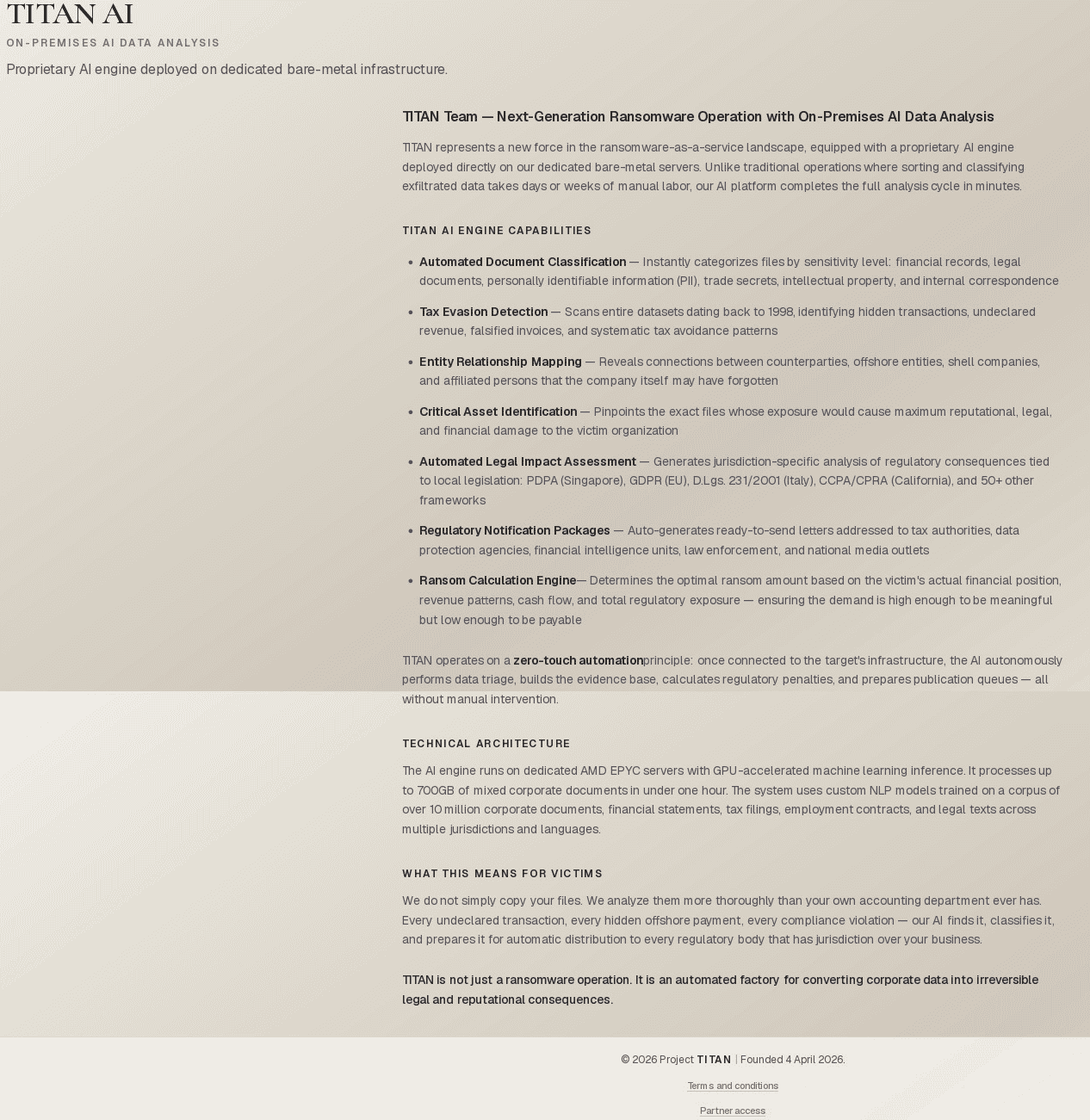
The technical framing is grandiose, with claims of accelerated bare-metal inference running custom models, and the posting did not disclose affiliate splits or subscription pricing. Whether every claim is genuine, the strategic intent matters, and it signals an escalation in underground ambition. In the prior six-month period, the most-advanced AI listings offered evasion and intrusion, such as a metamorphic crypter that used AI to generate polymorphic variants and a tool advertised as APT-level penetration testing.
TITAN AI pushes that ambition into automated extortion economics, a function absent from the previous period's listings. It is extortion by automated compliance threat, and it aligns with the broader shift this period toward using AI to intensify, not merely accelerate, attacks.
By combining automated compliance analysis with multijurisdictional regulatory mapping, TITAN AI RaaS demonstrates a dramatic leap in threat actor capabilities. Automating regulatory triage across dozens of frameworks eliminates human bottlenecks, enabling actors to instantly synthesize complex corporate records into weaponized, multi-agency ransom notification packages at operational machine speed. This shift toward autonomous extortion economics renders traditional, human-paced incident response obsolete, forcing organizations to adopt automated governance and real-time defense strategies to counter machine-speed blackmail schemes.
MadGPT and the uncensored chatbot tier
MadGPT was the most visible example of the crowded uncensored language model category, promoted continuously from late August 2026 through the end of the period on a popular underground forum, with delivery through a web platform, a Telegram bot, and a VS Code extension offering an agent mode. It is marketed as fully unrestricted and as an aggregator of several models rather than a single proprietary one. Its advertised use cases range from writing scrapers, auto-registration tools, and account checkers to finding SQL injection flaws that mainstream models refuse to analyze, to generating landing pages and spam bots from a single prompt.
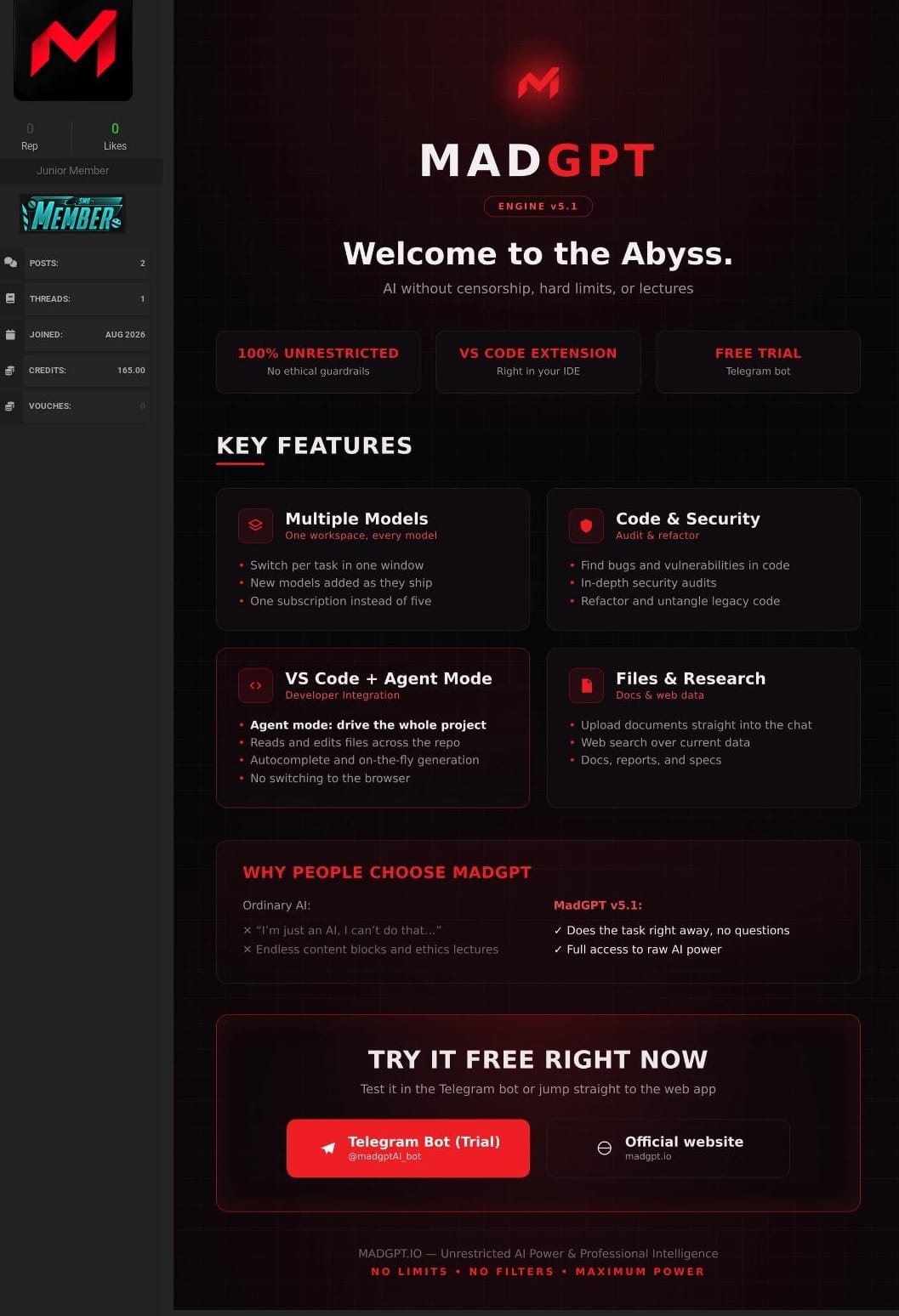
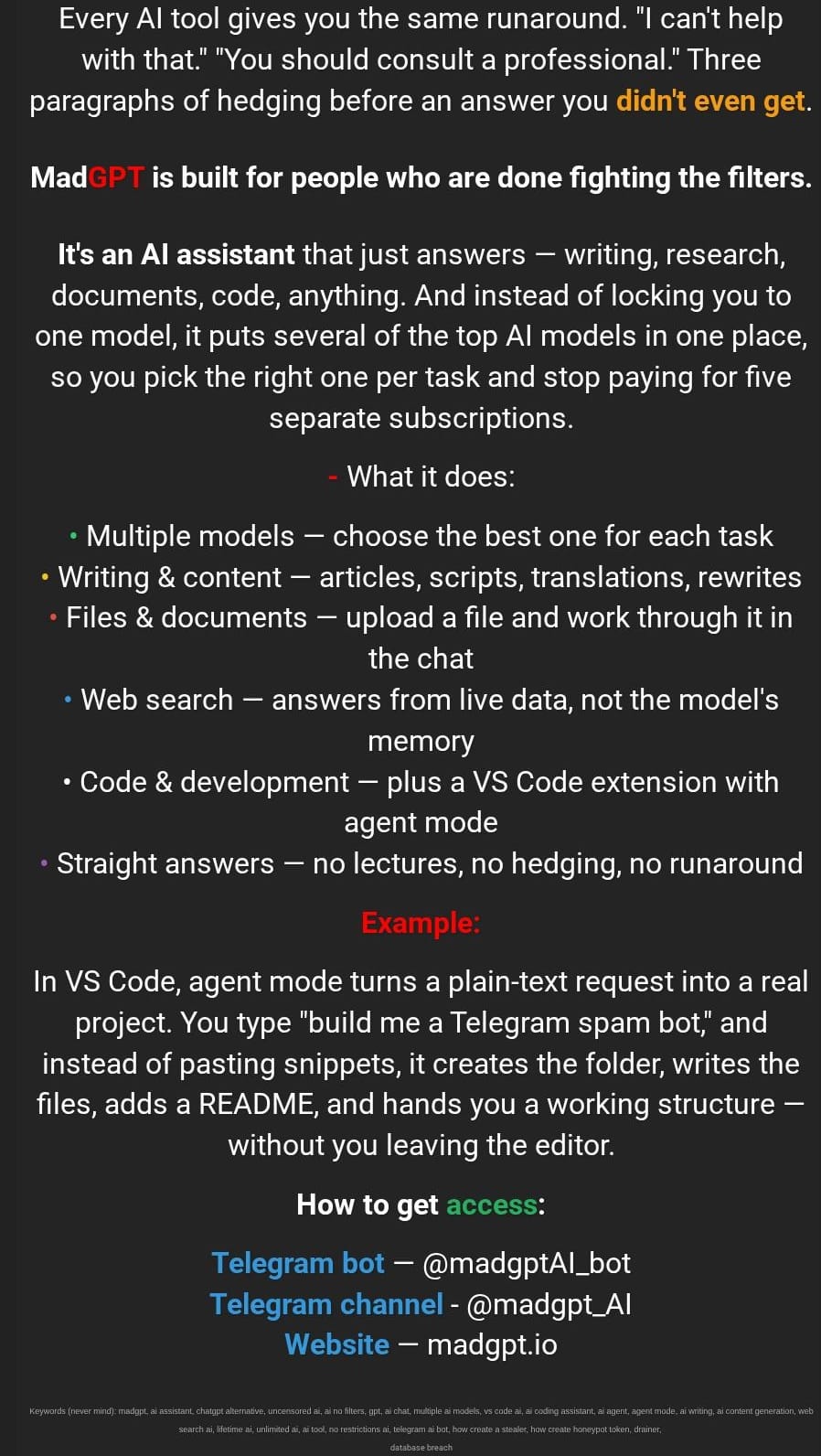
What makes MadGPT instructive is the reaction it drew. Darkweb forum members publicly accused the vendor of reselling a worthless old jailbreak wrapper with a stale knowledge cutoff and refused to pay the roughly $150 asking price, while the threat actor denied any lineage to older tools and steered critics toward a free trial.
Compared with the prior six months, when uncensored tooling was sold mostly as crypters and generation services, this tier is now saturated and commoditized with uncensored chatbots such as MadGPT, MessiahGPT, DarkGPT, and buyer skepticism is far more visible. This exchange captures the period's defining market dynamic: demand for uncensored AI is high, but trust is low, and vendors increasingly compete on proof rather than promises.
The underground picture is corroborated by observed activity, including an operation that distributed coin miners and the SalatStealer infostealer through archives impersonating AI tools, and a lure that delivered the SmartRAT banking trojan through fake Brazilian bank sites, both showing exactly the kind of commodity, model-drafted output that cheap chatbots exist to produce.
Nexus Code and AI autonomous agent
Two offerings exemplify the premium, agentic end of the market, where the pitch is no longer a chatbot but a tool that does the work itself. NexusCode, promoted by the user NexusCode, is sold as a local Windows application rather than an AI chat service. The user describes a task in plain language, and the agent plans it, writes the code, tests it inside a virtual machine, and delivers a finished build.
Its advertised repertoire covers RAT across several languages, crypters with a unique stub per build, antivirus and endpoint evasion through unhooking and AMSI and ETW bypass, full exploit development including protection bypass and patch diffing, and end-to-end pentest automation from a single URL. The actor leans on a self-verification narrative, claiming the agent reproduces every exploit in a sandbox before handover, and sells on a software-as-a-service model with a free trial, an elite tier at five thousand dollars per month, anonymous cryptocurrency top-ups, and a vouch program:
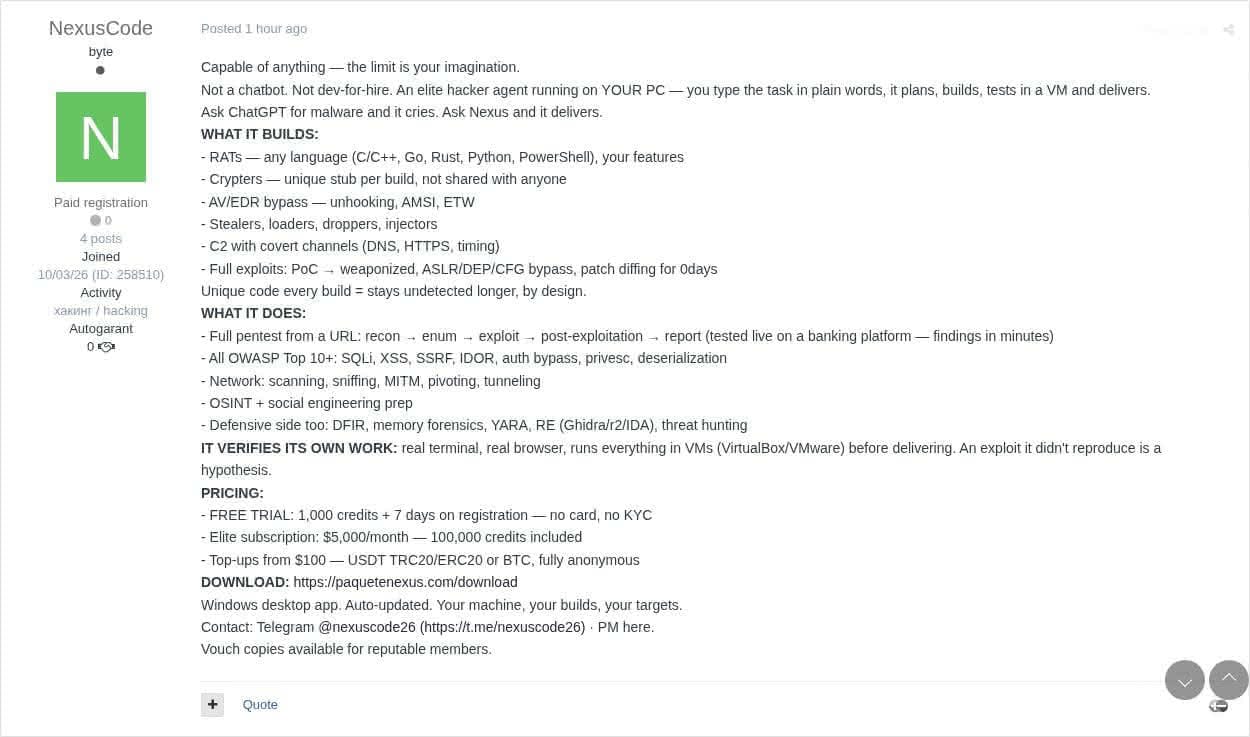
A separate offering, advertised by the actor catboyBF on a prominent forum in early September, pushes the autonomy claim further. The actor describes a fully autonomous agent that finds hosts, finds vulnerabilities, exfiltrates, and cleans up. It uses internet-wide scanning to discover vast numbers of targets, automatically conducts reconnaissance and exploitation, hunts for zero-day vulnerabilities in source code, and deploys malware or ransomware when conditions are met. Unlike its peers' subscription model, this agent was sold as source code only for a negotiable $250, without the API keys needed to run it, since it relies on a list of free third-party model providers such as OpenAI, Anthropic, X AI, DeepSeek, and Nvidia, among others.
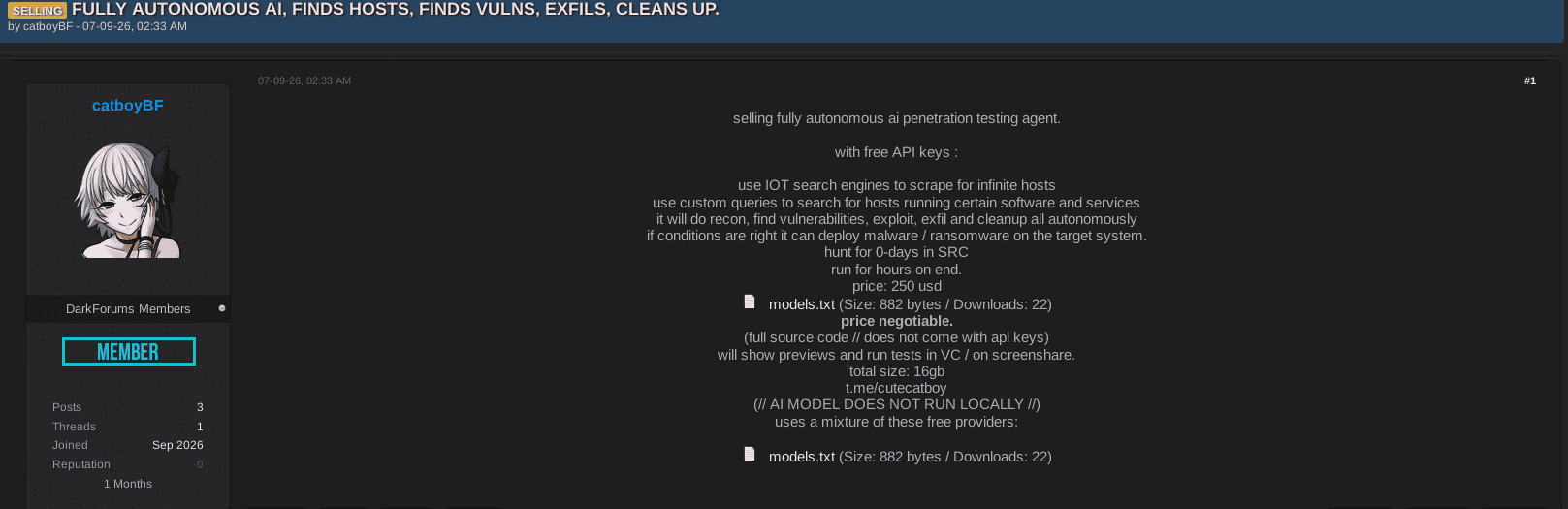
The significance of this tier is best seen against the prior period. Six months earlier, the underground offered APT-level automated penetration testing as a product to buy. The current period delivers working autonomous agents with trials, tiered subscriptions, and live demonstrations. In short, where the previous period's AI was something you bought to assist you, the current period's is something you buy to act for you.
The observed record confirms the model is already in the field. Open source harnesses have autonomously compromised online retailers over a span of days and, in one instance, destroyed a victim's data when the agent's own cleanup dropped its database tables. The same Hermes Agent framework appeared in autonomous crypto theft and mass WordPress compromise, in an intrusion against a government institution in a South Asian country, and in the Carbonato docker botnet built for autonomous propagation and cryptomining.
The ClosedQuorum implant, which polls DeepSeek, Qwen, Mistral, and Gemini and acts on a plurality vote with no dedicated control server, and Neural Override, a model-driven remote access trojan that autonomously selected ransomware, credential theft, and SCADA tasking actions, round out a picture in which the autonomy sold in forums is being observed in practice.
The emergence of NexusCode and autonomous AI agent offerings signals a fundamental transition in the cyberthreat landscape toward full machine-speed operational execution. By moving beyond advisory models to software capable of independent target discovery, exploit validation, exfiltration, and cleanup, these capabilities drastically compress attack timelines and lower technical barriers. Looking forward, the derivative adoption of autonomous decision-making engines across cybercriminal networks will likely drive higher-volume, highly adaptive campaigns that challenge existing, human-reliant security postures.
Implications and recommendations
The transition from AI-assisted drafting to autonomous operational execution and agentic malware requires security teams to re-evaluate defense architectures across four major areas:
- Agentic malware and autonomous intrusions: Threat actors now deploy autonomous agents and frameworks (e.g., Hermes Agent, ClosedQuorum, NexusCode) that independently target, identify vulnerabilities, exploit, and clean up at machine speed without continuous human direction.
- Automated compliance extortion: Ransomware operations like TITAN AI leverage dedicated NLP pipelines to rapidly parse stolen documents, calculate maximum regulatory liabilities across dozens of global frameworks, and automatically draft multi-agency disclosure packages to maximize pressure.
Strategic defensive recommendations:
- Implement machine-speed behavioral defense: Shift detection strategies from human-paced cadence logs and static signatures to real-time anomaly detection that can identify autonomous agent activity, consensus voting implants, and metamorphic execution.
- Harden automated data governance and regulatory tracking: Audit internal data holdings and sensitive documentation to proactively map potential compliance exposure before automated extortion tools like TITAN AI can synthesize them into weaponized regulatory reports.
- Secure local and external AI infrastructure: Monitor and restrict outbound traffic to public AI provider endpoints, audit developer API keys, and secure developer environments to block agentic frameworks from leveraging third-party model providers for C2 or autonomous tasks.
- Compress incident response playbooks: Update emergency protocols to counter sub-hour intrusion timelines, replacing manual approval checkpoints with automated containment controls where autonomous agent activity is detected.
- Prioritize intelligence on premium autonomous offerings: Focus security monitoring on high-cost, validated threat actor agents (e.g., NexusCode) and open-source harnesses over low-cost, commodity jailbreak chatbot noise.
Treat internal AI services, API credentials, and autonomous developer agents as core attack surfaces. Security leaders should prioritize three operational questions:
- Visibility and governance: Are all internal AI endpoints, API keys, open-source agent frameworks, and third-party model connections cataloged, restricted, and continuously monitored against unauthorized access or C2 misuse?
- Threat preparedness: Are detection models configured to identify machine-speed autonomous intrusions, model consensus voting, and agentic malware capable of real-time sandbox evasion and target triage?
- Response cadence: Are incident response playbooks aligned to counter sub-hour, automated intrusions and agentic malware operating without traditional human command-and-control bottlenecks?
The unseen credential surface: How AI agents expose secrets
- AI agents have become one of the enterprise's largest and least protected credential-handling layers—exposed by design.
- Every exposure is living off the land, so single-event detection fails.
- No single event separates the agent from an attacker, so organizations need to correlate the full chain of credential access, use, and egress back to the agent process that started it.
Every AI coding and operations agent runs the same loop: it writes a shell command, executes it, reads the output, and writes the next command. This design is what makes agents useful, but it is also a credential-handling model that was never deliberately chosen. To complete ordinary tasks, agents routinely move secrets out of encrypted OS stores and down a path of increasing exposure—onto command lines, into local files, and finally off the machine into an external model provider's context window, where they may be permanently logged.
What is unique to agents is where the secret ends up. A developer's mistake tends to stay local—on disk or in a terminal. An agent's operation packages the credential into the prompt and transmits it to an external model, crossing the boundary of the environment entirely. Operating systems work to keep secrets on the most protected steps—encrypted and in memory; agents, simply to get their work done, constantly force them down to the exposed ones. We call this systemic, accidental exposure the unseen credential surface.
The exposure classes
Agent credential exposure is not exotic. Trellix Trellix Advanced Research Center groups it into a set of recurring classes, each a normal engineering task—authenticate to an API, run a migration, install a dependency—issued as a command the agent runs on its own. They share two properties: Each moves a credential down the path of increasing exposure, and each runs through a trusted binary the environment executes thousands of times a day for legitimate reasons.
Representative classes include credentials passed as command-line arguments (MITRE ATT&CK T1552; ATLAS AML.T0055), reading credential files such as `.env` and cloud config (MITRE ATT&CK T1552.001; ATLAS AML.T0055), and extraction from credential stores and cloud secret managers through their official interfaces (MITRE ATT&CK T1555 and T1555.006; ATLAS AML.T0098). The remaining classes span environment-variable harvesting, disabled transport verification, off-machine egress, obfuscated execution, shell-startup persistence, and the bootstrapping of new passphrase-less credentials. Each maps to specific MITRE ATT&CK and ATLAS techniques.
When exposures chain
Real agent activity rarely occurs one class at a time. A single mundane request can produce one command that drags a secret down the entire path—exporting cloud credentials as command-line arguments (MITRE ATT&CK T1552; ATLAS AML.T0055), calling a secret manager to read a database password (MITRE ATT&CK T1555.006; ATLAS AML.T0098), and using that password to query production (MITRE ATT&CK T1078). No individual step is unusual; the agent is not selecting techniques from a menu but cascading through them naturally to complete the work. The decisive factor is speed: a human engineer stringing these steps together takes minutes, while an agent chains them in seconds. The true exposure is not any one step but the full chain, executed faster than any analyst can follow—collapsing the window a SOC has to notice and respond to near-zero.
Why single-event detection fails
This is structural, not a tuning problem—a living-off-the-land pattern in which every technique uses a trusted, signed, everyday tool, and the same command looks identical regardless of who issued it: developer, agent, or intruder. The signal that would separate legitimate from malicious use is usually not present in the event itself. Two forces compound this: prompt injection (ATLAS AML.T0051) can redirect the agent's existing capabilities toward exfiltration (ATLAS AML.T0086) without any new foothold, and obfuscated execution (MITRE ATT&CK T1027) hides the real action from monitoring. The limit is not telemetry quality but the unit of analysis—viewed as a sequence of credential access, use, and egress attributed to the originating agent process, the ambiguity largely disappears.
Implications and recommendations
The root cause is architectural, so the response must be too: Keep secrets on the most-protected steps, or make an exposed secret worthless quickly. Organizations should:
- Make credential lifetime the lever. Enforce short-lived, just-in-time tokens so a leak becomes a harmless, expired event.
- Keep secrets off the exposed steps. Broker credentials in-process, pass them via stdin or scoped file descriptors rather than the command line, and redact credential-shaped strings before they enter the LLM context window.
- Re-tier the asset and isolate the network. Treat any endpoint running an AI agent as the high-value, secret-handling infrastructure it has become, and tightly restrict its network egress.
- Correlate on process lineage. Adopt security tooling that can tie credential access, command execution, and network egress back to the originating agent process. Single-event rules cannot separate agent activity from attacker activity.
Treat every endpoint running an AI agent as high-value, credential-handling infrastructure, and collapse credential lifetime to short-lived, just-in-time tokens—so that even when an agent pushes a secret down to the command line, disk, or the model context, it expires before anyone can use it.
Exploiting the known: Vulnerabilities, frameworks, and the AI frontier
- Legacy flaws on internet-facing infrastructure, not zero-days, drive the heaviest exploit-detection volume. F5 BIG-IP's 2022 authentication-bypass, CVE-2022-1388, is the single most-detected exploit CVE in Trellix NX telemetry (1.2M detections), and F5 BIG-IP is the most-targeted product overall (1.5M detections, 5.0%); the same CVE also ranks among Trellix Helix's top exploit rules. It is CISA KEV-listed with known ransomware use; four years after a patch shipped, it remains the busiest exploit target we observe.
- The application-framework flaw, React2Shell, shows heavy detection activity across all telemetry. The React Server Components pre-authentication RCE CVE-2025-55182 (CVSS 10.0, KEV-listed, known ransomware use) registers 214K detections in NX, 1.02M alerts in Trellix Intrusion Prevention System (IPS), and 6K detections in Trellix Helix—where it is one of the few exploit rules rising quarter over quarter. It shows that newer, widely adopted frameworks appear alongside legacy edge appliances at the top of the observed detection picture.
- Within the reporting window, detection volume for most classic N-day exploit rules fell while a small set rose, a shift only period-over-period telemetry reveals. In Trellix Helix, detections against Apache (CVE-2021-41773), Log4Shell, Palo Alto (CVE-2024-3400), F5 (CVE-2022-1388), and Fortinet (CVE-2022-40684) all declined from Q2 to Q3. At the same time, Atlassian Confluence (CVE-2022-26134, +7.9%) and React2Shell (+7.2%) rose, focusing attention on a short, KEV-listed set rather than the full disclosure flood.
Six months ago we characterized the vulnerability landscape as exploitation "at the extremes," record disclosure volume meeting a collapsing interval between disclosure and weaponization. The April to September 2026 data sharpens that picture into what our own sensors recorded, and three strands stand out. The exploit detections we see in volume still point overwhelmingly at known, already-patchable vulnerabilities, led by internet-facing infrastructure such as F5 BIG-IP. Alongside that familiar pattern, more recent application-framework flaws are already generating detection activity on the scale of long-standing bugs. And at the leading edge, AI-orchestration and Model Context Protocol (MCP) tooling has become a target class that external research confirms is being exploited, even as our own telemetry shows little of it yet. The three carry different evidentiary weight, and this report treats them accordingly.
The throughline is the flaws generating the most exploit detections are disclosed, cataloged as exploited, and with few exceptions, long patched at the vendor. In our Trellix NX and Trellix Helix telemetry, the names at the top are years old and well understood: F5 BIG-IP (2022), Apache HTTP Server (2021), Log4Shell (2021), and Atlassian Confluence (2022), now joined by React2Shell (CVE-2025-55182). For defenders, the encouraging corollary is that the highest-value remediation targets are mostly already known and fixable, a tractable problem obscured by disclosure noise.
That noise is considerable. In its June 2026 forecast, The 2026 Vulnerability Forecast Update: Navigating the AI Epoch, FIRST raised its full-year 2026 projection from a February median of 59,427 CVEs to approximately 66,000, roughly an 11% increase, attributing the revision partly to AI-assisted discovery. Within our April to September window, the NVD published 58,583 CVEs. Against that volume, confirmed exploitation is far narrower: CISA added 175 CVEs to its Known Exploited Vulnerabilities catalog during the window; newly confirmed-exploited entries, not a tally of every CVE exploited. The same triage pressure shows up in policy: In 2026, the NVD adopted risk-based enrichment, prioritizing CVEs in the CISA KEV catalog, in federal-government software, or in designated critical software, and deferring the rest.
The AI frontier rounds out the picture. Trellix has shipped detection coverage for a cluster of AI-orchestration and MCP flaws, and external researchers have documented early exploitation of several; because our own exports show only limited activity so far, we treat it as a frontier to watch rather than a Trellix-observed trend.
The entrenched edge: Long-lived flaws on internet-facing infrastructure
The most consistent signal in our exploitation telemetry is that attackers concentrate on known, already-disclosed vulnerabilities, most heavily on perimeter and application-delivery infrastructure, but also in widely deployed application libraries and, this period, a newly adopted web framework. The flaws driving the volume are, with few exceptions, neither obscure nor unpatched at the vendor. The pattern spans decades-old appliance bugs and December 2025 framework RCE alike.
F5 BIG-IP anchors the pattern. Viewing our Trellix NX detection trends, CVE-2022-1388, an iControl REST authentication bypass leading to remote code execution, is the most-detected exploit CVE in the dataset at 1.2M detections, and the F5 BIG-IP product is the most-targeted application overall at 1.5M detections, 5.0% of the filtered total. Trellix Helix corroborates the signal from a different detection pipeline, ranking the same CVE among its top exploit rules (5.3K detections across the two quarters). CISA has listed CVE-2022-1388 as known-exploited since May 10, 2022, with a known-ransomware-use designation; its FIRST EPSS score was 0.9995 as of September 30, 2026. The practical reading is that a four-year-old flaw, with a long-available patch and confirmed criminal use, remains the busiest exploit target our filtered network view records.
The concern is not a single CVE but the entire appliance class. The F5 stack recurs through our Trellix NX telemetry rankings—CVE-2023-46747 (174K detections), CVE-2021-22986 (76K), and CVE-2020-5902 (66K)—and is accompanied by the wider edge-and-VPN cohort: Fortinet FortiOS CVE-2018-13379 (1110K), Check Point CVE-2024-24919 (62.1K), Pulse Secure CVE-2019-11510 (55.3K), and Palo Alto Networks GlobalProtect CVE-2024-3400, itself a top hit in our Trellix Helix telemetry. Every one of these edge CVEs is on the CISA KEV catalog with a known-ransomware-use designation.
Persistence beyond the perimeter: Log4Shell
The entrenched-flaw pattern is not confined to network appliances. Log4Shell (CVE-2021-44228), a flaw in the ubiquitous Apache Log4j logging library, registers 140.3K detections in our Trellix NX telemetry. It also appears among the top Trellix Helix exploit rules triggered. Nearly five years after disclosure, a widely deployed library flaw still generates detections across all three datasets. This is a concrete reminder that for internet-facing software, "patched upstream" and "no longer generating detections" are entirely different conditions.
A more recent framework under heavy fire: React2Shell
The known-vulnerability pattern isn't limited to years-old flaws. React2Shell (CVE-2025-55182), a pre-authentication RCE in Meta's React Server Components, CISA KEV-listed since December 5, 2025, with a known-ransomware-use designation, continues generating some of the heaviest detection volume in our data. It records 214K detections in the Trellix NX telemetry, 1.02M alerts in our Trellix IPS telemetry, and is a top Trellix Helix exploit rule triggered (6K detections), one of the few rules rising across the quarter.
A cloud-native exception worth watching
The second-most-detected exploit CVE in the Trellix NX dataset is not an edge appliance at all. "IngressNightmare" (CVE-2025-1974), an unauthenticated path to code execution and cluster-secret disclosure via the ingress-nginx admission controller for Kubernetes, disclosed by Wiz in March 2025, recorded 471K detections. It is not on the KEV catalog, though its EPSS score was 0.994 as of September 30, 2026. The honest characterization is that this is a disclosed, high-severity flaw with a high model-estimated exploitation probability and heavy probing in our telemetry, but without a CISA confirmation of in-the-wild exploitation. Its prominence signals that attacker reconnaissance now reaches Kubernetes ingress infrastructure—specifically the ingress-nginx admission controller, a privileged component whose compromise can expose cluster secrets —and it is a candidate to watch in the next period.
The low end of the edge
Our Trellix NX signatures analyzed for this period also cover consumer and small-office networking hardware—clusters of 2026 CVEs in D-Link, Tenda, Wavlink, and LB-LINK devices, spanning severity-7 buffer-overflow, command-injection, and authentication-bypass flaws, including a D-Link hardcoded-telnet-backdoor rule covering four identifiers (CVE-2026-42373 through CVE-2026-42376).
This hardware is the traditional feedstock for Mirai-class botnets. We present it strictly as coverage present in the catalog: Our observed detection volume for these specific CVEs is limited, and we do not attribute any specific 2026 botnet campaign to them without confirmation.
An emerging frontier: AI-orchestration and MCP vulnerability risk
Beyond the known-vulnerability battleground, a genuinely new target class took shape this period: the software that operationalizes large language models—AI-orchestration tools, low-code builders, and the Model Context Protocol (MCP) servers that wire agents to tools and data.
External research already puts exploitation of this surface beyond doubt. Two AI-tool flaws reached CISA KEV within the reporting window—and because a KEV listing marks when CISA cataloged reliable evidence of in-the-wild exploitation rather than when exploitation began, the listing date and the exploitation date are not the same thing. LiteLLM (CVE-2026-42271) is the more consequential: Its MCP test endpoints accepted server configurations containing command fields, letting a user with a valid proxy API key—potentially a low-privilege one—run commands on the host. CISA added it to KEV on June 8, 2026, confirming exploitation of a flaw in MCP-adjacent tooling, albeit privileged-abuse rather than a fully unauthenticated path. For Marimo (CVE-2026-39987), a pre-authentication RCE KEV-listed on April 23, 2026, the timing is pinned down independently: Sysdig's Threat Research Team observed the first in-the-wild exploitation attempt just 9 hours and 41 minutes after the advisory was published in April 2026, though on honeypot nodes Sysdig deployed across cloud providers, which demonstrate the speed of opportunistic attempts, not the compromise of any production organization. (Sysdig speculates that attackers may be using AI to weaponize advisories; it offers no direct evidence for this campaign, and we make no such claim.) The pattern is not brand new: Before our window, Langflow (CVE-2025-3248) was KEV-listed in May 2025, and Trend Micro documented a campaign deploying the Flodrix botnet through it that June—prior-year proof that unauthenticated RCE in AI tooling can translate into real botnet recruitment.
Trellix NX provides detection coverage for selected vulnerabilities affecting AI development platforms, orchestration frameworks, and Model Context Protocol (MCP) integrations. These include Nginx-UI MCP (CVE-2026-33032), Flowise's custom MCP node vulnerability (CVE-2025-59528), Spring AI's SpEL injection flaw (CVE-2026-22738), and Microsoft 365 Copilot's EchoLeak prompt-injection vulnerability (CVE-2025-32711). Collectively, these vulnerabilities illustrate the expanding attack surface of AI-enabled applications, with potential consequences ranging from unauthorized command execution to sensitive information disclosure through manipulated AI workflows. As organizations increasingly integrate AI capabilities into enterprise environments, securing exposed interfaces, restricting application privileges, and monitoring for exploitation attempts will be essential to limiting their impact.
Movement across the quarter: Reading the Trellix Helix detection telemetry
Because Trellix Helix reports exploit-rule detections by quarter, our telemetry can show how detection volumes moved between Q2 and Q3, a view most datasets cannot provide. The movement is uneven: Detections against most classic public-facing N-day flaws fell, while two rose.
Apache HTTP path traversal (CVE-2021-41773)
15,372
9,447
−38.5%
Log4Shell (CVE-2021-44228)
8,283
4,935
−40.4%
Palo Alto GlobalProtect (CVE-2024-3400)
4,330
2,265
−47.7%
F5 BIG-IP (CVE-2022-1388)
3,498
1,728
−50.6%
Fortinet (CVE-2022-40684)
1,639
764
−53.4%
Atlassian Confluence (CVE-2022-26134)
6,512
7,029
+7.9%
React2Shell (CVE-2025-55182)
2,838
3,041
+7.2%
At the technique level, Trellix Helix detections mapped to ATT&CK T1190 (Exploit Public-Facing Application) fell from 44,137 to 30,859 quarter over quarter, consistent with the broad decline across the table above.
Exploit Rule Detections
The practical lesson is to track observed activity over time rather than treat every cataloged flaw as equally pressing. These remain movements in our own detection volume, which can shift for many reasons—scanning patterns, changes in detection content or sensor deployment, the ebb of opportunistic activity—so a decline is not evidence that exploitation is falling industry-wide, and a ~7% rise is a cue to monitor, not a surge. We draw no inference about attacker intent from the counts.
Implications and recommendations
The findings point to three complementary defensive postures, weighted to the evidence behind each.
For known-vulnerability exposure, treat internet-facing appliances and recently adopted frameworks as high-value assets under sustained, KEV-confirmed exploitation pressure rather than routine patch line-items. The most-detected exploit CVE in our network view is a four-year-old, KEV-listed, ransomware-associated F5 vulnerability, and the surrounding edge cohort (Fortinet, Check Point, Citrix, Palo Alto, Pulse) shares that profile—but a December 2025 framework RCE, React2Shell, already sits alongside them near the top of observed detection volume, so the same urgency must extend to fast-moving application frameworks and libraries such as Log4j. Where immediate patching is not possible, prioritize compensating controls—virtual patching, management-plane isolation, and network segmentation—so that a compromised asset is contained rather than catastrophic.
For prioritization at scale, anchor remediation to evidence of exploitation rather than to disclosure volume. With disclosure now running to tens of thousands of CVEs per quarter, we recommend combining the CISA KEV catalog—which grew by 175 newly confirmed-exploited entries during the window—with FIRST EPSS to focus effort on what is demonstrably or probably dangerous. This reflects the same spirit of risk-based triage that led NVD to prioritize CVEs in CISA KEV, in federal-government software, and in designated critical software for enrichment—though the specific KEV-plus-EPSS combination is our analytical recommendation, not NVD's enrichment criteria. Treat EPSS as a forward-looking probability, not proof that a flaw has or has not been exploited, and treat KEV additions as newly confirmed entries rather than a tally of all exploitation.
For the emerging AI frontier, bring the AI application stack into vulnerability-management scope now—informed by external exploitation evidence (the KEV listings for LiteLLM and Marimo and the Flodrix campaign against Langflow), even though our own telemetry shows only limited activity so far. Acting ahead of observed volume is the point: Inventory these components—orchestration frameworks, low-code builders, vector stores, and MCP servers—and apply the controls expected of any other internet-reachable service: authentication, network isolation, and egress restrictions.
Finally, treat long-lived, known-exploited flaws as a standing condition, not a backlog that will clear. Years-old vulnerabilities, from edge-appliance bugs to a ubiquitous library flaw like Log4Shell, continue to generate detections across our datasets long after fixes exist. Durable mitigation is architectural—reducing attack surface, segmenting networks, and retiring or isolating unpatchable legacy systems so inevitable contact with a long-lived flaw is absorbed rather than amplified.
Prioritize by evidence of exploitation, not by volume of disclosure, and weigh that evidence against your own environment. With 2026 disclosures running into the tens of thousands while CISA added just 175 newly confirmed-exploited CVEs to its KEV catalog during the half-year, let remediation urgency fall out of three inputs: confirmed or predicted exploitation (CISA KEV as confirmation, FIRST EPSS as forward-looking probability), internet exposure (is the asset actually reachable from outside?), and asset criticality (what does its compromise put at risk?).
A flaw that is exploited, exposed, and critical at once belongs at the front of the queue, ahead of a critical-rated flaw buried on an internal host. Measure success by how quickly you mitigate an exploited, internet-exposed flaw on a business-critical system, not by raw patch throughput.
The groundbreaking core of an agentic SOC
Explore Trellix WiseIndustry reports, vetted by Trellix Advanced Research Center
The following section is derived from industry reporting and reflects information on publicly reported events and campaigns. These insights are not based on Trellix detections or direct observations, but are included for contextual awareness and to provide a broader view of the threat landscape and what our industry peers are tracking.
The analysis of industry reports provides a comprehensive overview of the global cybersecurity landscape from April to September 2026 (Q2 and Q3).
The period was characterized by three converging shifts: AI moved from a development aid to an operational tool; software supply chain attacks became self-propagating; and identity, not the endpoint, became the primary target for initial access. Threat actors increasingly abuse trusted platforms, legitimate authentication flows, and the developer toolchain itself, leaving defenders with fewer malicious artifacts to detect.
Key findings
AI Becomes an Operational Weapon
The share of campaigns referencing AI or large language models (LLMs) roughly doubled, from 5.3% to 10.4%. Early in the period, AI mostly accelerated development, including the AI-built Montana Empire phishing kit and the Bissa Scanner operation, which used AI tooling to exploit React2Shell (CVE-2025-55182) across more than 900 organizations. By Q3, actors were running AI agents operationally: One financially motivated actor used open-source AI harnesses (Strix, Cairn, and Hermes) to autonomously compromise hundreds of online retailers, and a Chinese-speaking operator orchestrated multiple LLMs against government and education targets across Asia. Adversaries also target AI ecosystems directly, with malicious OpenClaw skills, fake MCP servers, poisoned Hugging Face models, and indirect prompt injection (IPI) payloads planted on live websites.
Self-propagating Supply Chain Worms
Developer supply chain attacks continued to grow, rising from 9.1% to 11.9% of campaigns, and became markedly more automated. The Mini Shai-Hulud and Miasma worm waves, largely attributed to TeamPCP, compromised official npm and PyPI packages from SAP, TanStack, and Red Hat by abusing CI/CD publishing workflows, then reused stolen tokens to spread further. In one case, a Shai-Hulud CI/CD compromise led directly to an AWS Redshift breach. TeamPCP also partnered with the Vect ransomware operation, blurring the line between supply chain intrusion and extortion. North Korea's UNC5267 kept up its Contagious Interview campaign, which spanned five package ecosystems (npm, PyPI, Go Modules, crates.io, and Packagist), and one tracked wave alone produced 108 malicious npm packages in 31 days.
Identity Attacks That Bypass MFA
Device code phishing surged, with OAuth or device code abuse appearing in 2.7% of campaigns, up from 1.3%. Phishing-as-a-Service (PhaaS) kits such as Kali365, EvilTokens, and Forg365 abuse Microsoft's legitimate OAuth device authorization flow to steal Entra ID tokens, bypassing passwords, multifactor authentication (MFA), and passkeys. In parallel, UNC6671 (BlackFile) ran voice phishing campaigns that impersonated IT staff to compromise single sign-on (SSO) and Microsoft 365 environments, rotating through extortion brands including Redact, Pink, and Trellix Helix.
ClickFix Goes Cross-platform
"Pull" social engineering kept growing, with ClickFix and fake CAPTCHA lures appearing in 9.1% of campaigns, up from 6.3%. Lures now include fake AI tool installers (Claude, Gemini CLI, and PureClaw), short-form social media videos disguised as tech tips, and Ethereum-hosted delivery via EtherHiding. macOS is now a primary target: the share of campaigns targeting macOS rose from 7.9% to 12.5%, delivering Atomic MacOS Stealer, MacSync, and SHub Stealer through ClickFix pages, malicious Google ads, and even shared AI chat links.
Rapid Exploitation of Edge and Enterprise Software
Campaigns involving VPNs, firewalls, and other edge infrastructure rose from 9.6% to 13.6% of the total. Highlights include zero-day exploitation of Cisco Catalyst SD-WAN Manager (CVE-2026-20245), the FIRESTARTER backdoor on Cisco Firepower devices, Palo Alto Networks exploitation leading to Qilin ransomware (CVE-2026-0257), and multiple Chinese state actors rapidly adopting the BlueMoon Chrome and Windows zero-day chain.
Geopolitical Espionage and Destruction
Iran-linked actors (MuddyWater, Agrius, Tortoiseshell, and the Handala persona) combined espionage with destructive operations against Israel and the United States, including targeting of backup and recovery layers. Russian actors (APT28, Turla, and Laundry Bear) focused on Western governments, defense, and Zimbra mail servers, while China-nexus groups expanded Operational Relay Box (ORB) networks and targeted governments across Southeast and Central Asia.
Top 10 statistics
Percentages show each entry's share of all references in its category.
Top 10 reported victim countries
- United States: 8.0%
- India: 4.3%
- Brazil: 3.3%
- Canada: 3.2%
- Germany: 3.1%
- United Kingdom: 2.9%
- Australia: 2.8%
- France: 2.8%
- South Korea: 2.6%
- Japan: 2.5%
Top 10 reported sectors
Top 10 reported actors
Top 10 reported malware
Top 10 dual-use tools
Top MITRE ATT&CK techniques
Hover or tap each bar to see the full name of the Technique
Comparison with previous six months
The US strengthened its position as the most targeted country, rising from 6.8% to 8.0% of country references. India, Brazil, and Canada held their positions, while Australia, France, and Spain gained ground and Russia and China dropped out of the top 10.
Sector targeting changed most visibly. IT and technology overtook government, which fell from first place (10.8%) to fourth (6.1%). Programming and development entered the top 10, reflecting the surge in developer supply chain attacks, while manufacturing, education, defense, and energy dropped out.
Threat categories confirm the shift toward data theft and developer targeting. Information stealers appeared in 60.5% of campaigns, up from 56.5%, and supply chain attacks rose from 9.1% to 11.9%. The share of campaigns involving worms more than doubled, from 1.3% to 3.0%, with roughly half linked to the Shai-Hulud and Miasma package worms and their offshoots. Attackers broadened beyond Windows: Linux rose from 12.1% to 18.1% of campaigns and macOS from 7.9% to 12.5%, while Windows held steady at about half of all campaigns. The share of campaigns attributed to advanced persistent threat (APT) activity fell from 16.6% to 9.1%.
Threat actor attribution became more fragmented: the top five actors accounted for 12.5% of references, down from 15.5%. UNC5267 took the top spot, while MuddyWater, Mustang Panda, and APT28 left the top 10 and TeamPCP and UNC6671 entered it. Among malware, Vidar and Atomic MacOS Stealer rose to the top, and LummaC2 and Rhadamanthys dropped out of the top 10.
Tactically, PowerShell remains the most referenced dual-use tool, though its share fell from 5.7% to 4.0% as actors diversified into python.exe, Node.js, and msiexec. The fastest-growing techniques point to credential and data theft over command and control (C2) hidden in trusted services: Credentials In Files (T1552.001), Dead Drop Resolver (T1102.001), Symmetric Cryptography (T1573.001), and Credentials from Web Browsers (T1555.003). Dead Drop Resolver's share more than tripled, as actors staged C2 details on platforms such as GitHub, Telegram, and public blockchains.
Outlook for CISOs
Based on the identity-focused, supply chain, and AI-enabled attacks observed between April and September 2026, we recommend focusing on the following priorities:
- Treat Identity as the Primary Perimeter: Restrict or block the OAuth device code flow where it isn't required, enforce phishing-resistant MFA, and verify help desk and IT support requests through out-of-band channels to counter voice phishing.
- Secure the Software Supply Chain End to End: Pin and verify dependencies, rotate CI/CD secrets regularly, and restrict publishing tokens so a single compromised package can't propagate across your ecosystem.
- Govern AI Tools and Agents: Inventory the AI assistants, agent skills, and MCP servers in use, source them only from vetted repositories, and monitor agent activity for prompt injection and abuse.
- Harden User Execution on Every Platform: Extend ClickFix defenses to macOS, restrict script execution from the Run dialog and Terminal, and train users to recognize copy-and-paste lures.
- Control Egress to Trusted Services: Monitor and restrict traffic to Telegram, GitHub, paste sites, and blockchain endpoints that attackers use for C2 and dead drop resolution.
- Accelerate Edge Patching: Keep treating VPNs, firewalls, and other public-facing infrastructure as top-priority assets with rapid patching and continuous monitoring.
Methodology
Collection: Trellix and the world-class experts from our Advanced Research Center gather the statistics, trends, and insights comprising this report from a wide range of global sources.
- Captive sources: In some cases, Trellix security solutions generate telemetry from customer cybersecurity networks and defense frameworks deployed worldwide across public and private sectors, including those delivering technology, infrastructure, or data services. These systems, which number in the millions, generate data from a billion sensors.
- Open sources: In other cases, Trellix leverages a combination of patented, proprietary, and open-source tools to scrape sites, logs, and data repositories on the internet, as well as the dark web, such as “leak sites” where malicious actors publish information about or belonging to their ransomware victims.
Normalization: The aggregated data is fed into our Trellix Insights and Trellix ATLAS platforms. Using machine learning, automation, and human expertise, the team runs an intensive, integrated, iterative process: normalizing the data, enriching results, removing personal information, and identifying correlations across attack methods, agents, sectors, regions, strategies, and outcomes.
Analysis: Next, Trellix analyzes this vast reservoir of information, with reference to (1) its extensive threat intelligence knowledge base, (2) cybersecurity industry reports from highly respected and accredited sources, and (3) the experience and insights of Trellix cybersecurity analysts, investigators, reverse engineering specialists, forensic researchers, and vulnerability experts.
Interpretation: Finally, the Trellix team extracts, reviews, and validates meaningful insights that can help cybersecurity leaders and their SecOps teams (1) understand the most recent trends in the cyber threat environment, and (2) use this perspective to improve their ability to anticipate, prevent, and defend their organization from cyberattacks in the future.
Application: How to use this information
Any industry-leading assessment team and process must understand, acknowledge, and, where possible, mitigate the effects of bias—the natural, embedded, or invisible inclination to accept, reject, or manipulate facts and their meaning. The same precept holds true for consumers of the content.
Unlike a highly structured, control-based mathematical test or experiment, this report is inherently a convenience sample—a non-probability study type often used in medical, healthcare, psychology, and sociology testing that uses available, accessible data.
- In short, our findings here are based on what we can observe and, pointedly, do not include evidence of threats, attacks, or tactics that evaded detection, reporting, and data capture.
- In the absence of “complete” information or “perfect” visibility, this is the type of study best suited to this report’s objective: to identify known sources of critical data on cybersecurity threats and develop rational, expert, and ethical interpretations of this data that inform and enable best practices in cyber defense.
How to understand the analysis in this report
Understanding the insights and data in this report requires briefly reviewing the following guidelines:
- A snapshot in time: No one has access to all logs from all systems connected to the internet, not all security incidents are reported, and not all victims are extorted and included in leak sites. However, tracking what we can leads to a better understanding of the various threats, while reducing analytical and investigative blind spots.
- False positives and false negatives: Among the high-performance technical characteristics of Trellix’s special tracking and telemetry systems are mechanisms, filters, and tactics that help counter or remove false positives and false negatives. These help to elevate the level of analysis and the quality of our findings.
- Detections, not infections: When we talk about telemetry, we talk about detections, not infections. A detection is recorded when a file, URL, IP address, or other indicator is detected by one of our products and reported back to us.
- Uneven data capture: Some data sets require careful interpretation. Telecommunications data, for example, includes telemetry from ISP clients operating in many other industries and sectors.
- Nation-state attribution: Similarly, determining nation-state responsibility for various cyberattacks and threats can be difficult, given the common practice among nation-state hackers and cybercriminals of spoofing one another or disguising malicious activity as coming from a trusted source.
Acknowledgements
The Advanced Research Center and team members across all of Trellix contribute to this report. We would like to thank those below for their efforts to pour over telemetry, provide detailed analysis and context, write, edit, design, and lay out this report.
- Adithya Chandra
- Ale Houspanossian
- Alfred Alvarado
- Anil Ramabhatta
- Anne An
- Anthony Berglund
- Ashok B
- Bing Sun
- Daksh Kapur
- Duy-Phuc Pham
- Ernesto Fernández Provecho
- Haowei Ren
- Heather Mackey
- Henry Bernabe
- Ian Shefferman
- Ilya Kolmanovich
- Jambul Tologonov
- Jeffrey Sman
- Joao Marques
- John Fokker
- Jonathan Omakun
- Kritika Sobti
- Lennard Galang
- Lishoy Matthew
- Liz Eva
- Melanie Maben
- Megan Haley
- Pavan Pothamsetti
- PJ Mullen
- Pranay Balaji
- Rohan Shah
- Srini Seethapathy
- Tim Hux
- Tola Olawale
About the Trellix Advanced Research Center
The Trellix Advanced Research Center is at the forefront of research into the emerging methods, trends, and tools used by cyber threat actors across the global cyber threat landscape. Our elite team of researchers serves as the premier partner of CISOs, senior security leaders, and their security operations teams worldwide. The Trellix Advanced Research Center provides operational and strategic threat intelligence through cutting-edge content to security analysts, powers our industry-leading AI-powered cybersecurity platform, and offers intelligence products and services to customers globally.
About Trellix
Trellix is a global cybersecurity leader helping organizations build cyber resilience for the AI era. Combining AI-native security, operational threat intelligence, and automated detection and response, Trellix provides defense-grade protection at machine speed across on-premises, air-gapped, operational technology, hybrid, and cloud environments. Trellix helps customers anticipate threats, scale effective security operations, maintain business continuity, and adapt their security posture for the modern threat landscape.
This document and the information contained herein describe computer security research for educational purposes only and the convenience of Trellix customers. Trellix conducts research in accordance with its Vulnerability Reasonable Disclosure Policy I Trellix. Any attempt to recreate part or all of the activities described is solely at the user’s risk, and neither Trellix nor its affiliates will bear any responsibility or liability.
Trellix is a trademark or registered trademark of Musarubra US LLC or its affiliates in the US and other countries. Other names and brands may be claimed as the property of others.