
Blogs
The latest cybersecurity trends, best practices, security vulnerabilities, and more

Beyond the Blind Spots: 5 Reasons Your Modern Security Stack is Still Failing and How an NDR Solution Can Help
By Adam Tomeo · September 30, 2026
Picture this: A sophisticated adversary compromises a single credential through a highly targeted spear-phishing attack. They bypass your SASE gateway, satisfy your ZTNA requirements with a legitimate (albeit stolen) token, and land on a server. From there, they don’t deploy a single piece of known malware. Instead, they use native administrative tools—the "Living off the Land" playbook—to glide laterally through your data center. Your endpoint detection and response (EDR) is silent because the commands look like routine maintenance. Your firewall is oblivious because the traffic is internal. We are witnessing a structural collapse of the traditional defensive perimeter.
Despite billions invested in "standard" stacks, the enterprise security gap is widening. Why? Because while EDR, SASE, and ZTNA are essential, they are predicated on assumptions of coverage and trust that no longer hold up in a world of unmanaged devices and AI-orchestrated attacks. To survive this era, we must move toward "Active" Network Detection and Response (NDR)—the only strategy that treats the network not as a passive transport layer, but as the untamperable source of truth. Here are the five most impactful shifts we are seeing through the Trellix NDR approach.
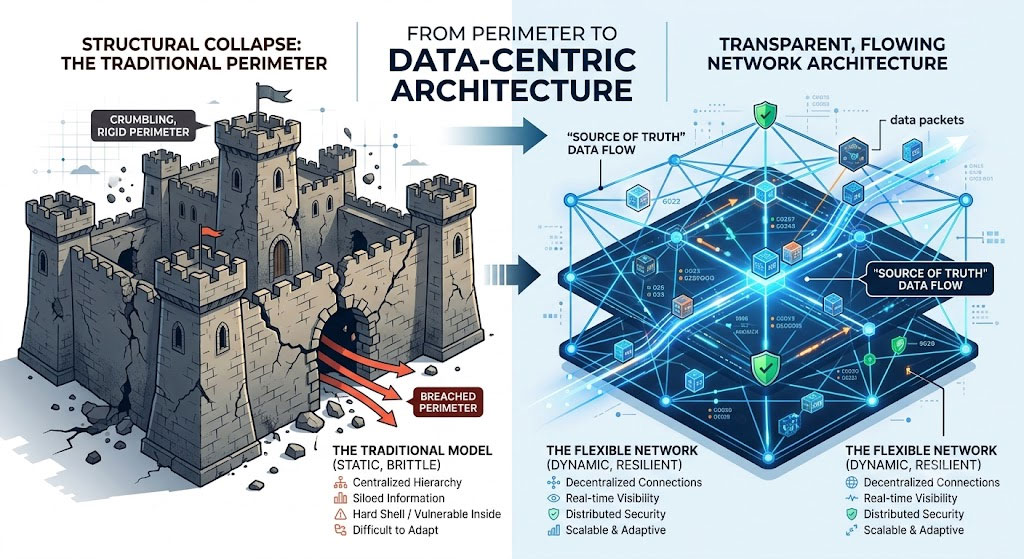
This image is generated by AI
1. The fatal flaw of the "software-defined witness"
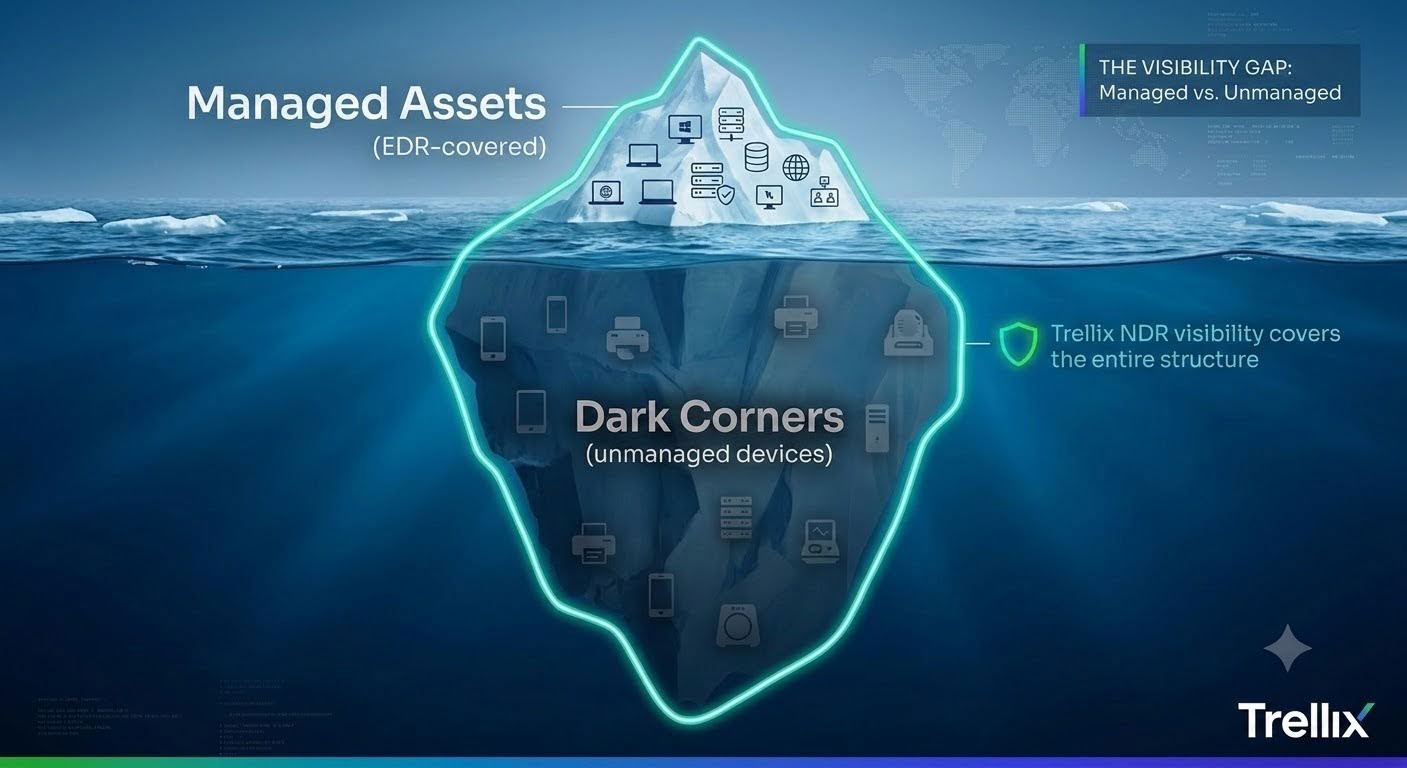
For too long, we’ve relied on EDR as our primary witness. But EDR is a software-defined witness, and witnesses can be intimidated, blinded, or silenced. Sophisticated attackers make it a priority to disable, blind, or delete EDR logs to cover their tracks. Furthermore, EDR only works where an agent can live. In the modern enterprise, the "dark corners" are growing.
This image is generated by AI
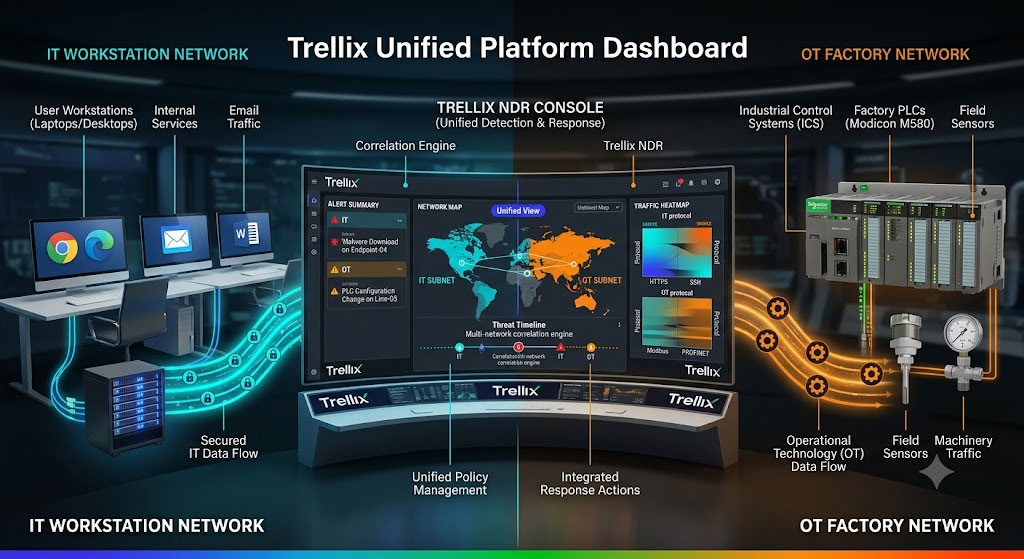
From IoT and smart building systems to critical operational technology (OT) and PLC hardware, there is a massive population of unmanaged devices that cannot support a security agent. Trellix NDR bridges this gap by monitoring network traffic—the physical reality of the environment. You can delete a log, but you cannot hide the physical packets sent across the wire. As one IT Services Associate noted via Gartner Peer Insights: "What I like most about Trellix NDR is its ability to detect advanced and hidden threats using network traffic analysis."
2. Unmasking "action chaining" and the Shadow AI perimeter
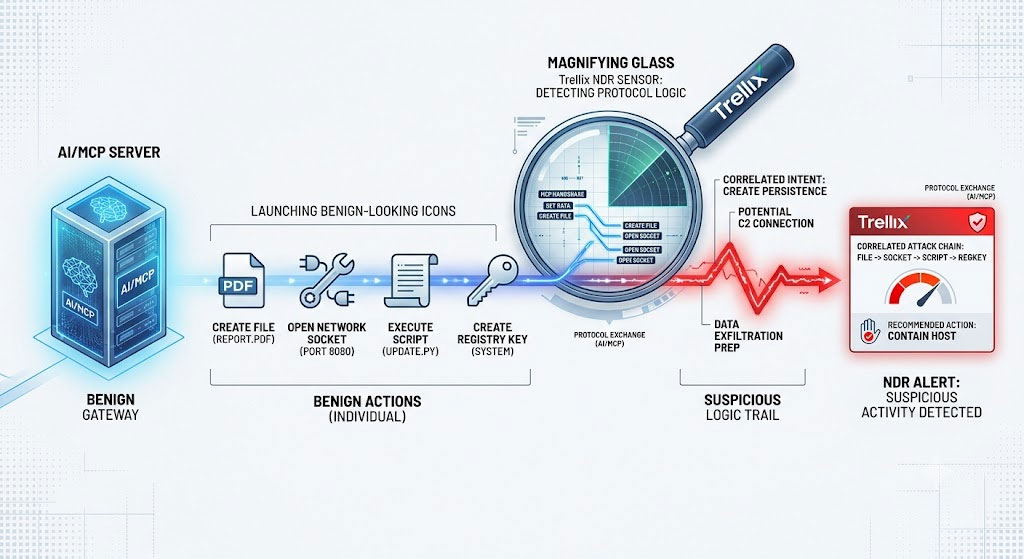
We are entering the era of the Model Context Protocol (MCP), a new frontier for productivity that is simultaneously opening a massive perimeter risk. We’re seeing a rise in Shadow AI, where developers inadvertently leave local or open-source MCP servers exposed to the network without robust access controls.Attackers are now utilizing MCP for "action chaining."
This image is generated by AI
This is a particularly insidious threat because the individual actions—requesting a file, opening a socket, executing a script—often look completely benign on the surface. They abuse legitimate features rather than malware signatures. Traditional tools miss the logic of the protocol exchange, but NDR provides the deep, protocol-level visibility required to unmask these stealthy Command-and-Control (C2) frameworks before they can be fully realized.
3. Fingerprinting the handshake: Visibility without the decryption tax
The rise of encrypted traffic (HTTPS/TLS) has created a "privacy envelope" that attackers use to hide malicious payloads. For years, the only answer was full decryption—a process that creates massive performance bottlenecks and introduces complex privacy and compliance headaches. The paradigm has shifted. Using JA3 and JARM fingerprinting, Trellix NDR can identify malicious activity by analyzing the handshake rather than the encrypted payload itself.

This image is generated by AI
This allows security teams to unmask malicious tunnels and identify suspicious behavior while preserving both network performance and user privacy. We no longer need to break the envelope to know the letter inside is a threat.
4. Active NDR: The only network defense that fights back
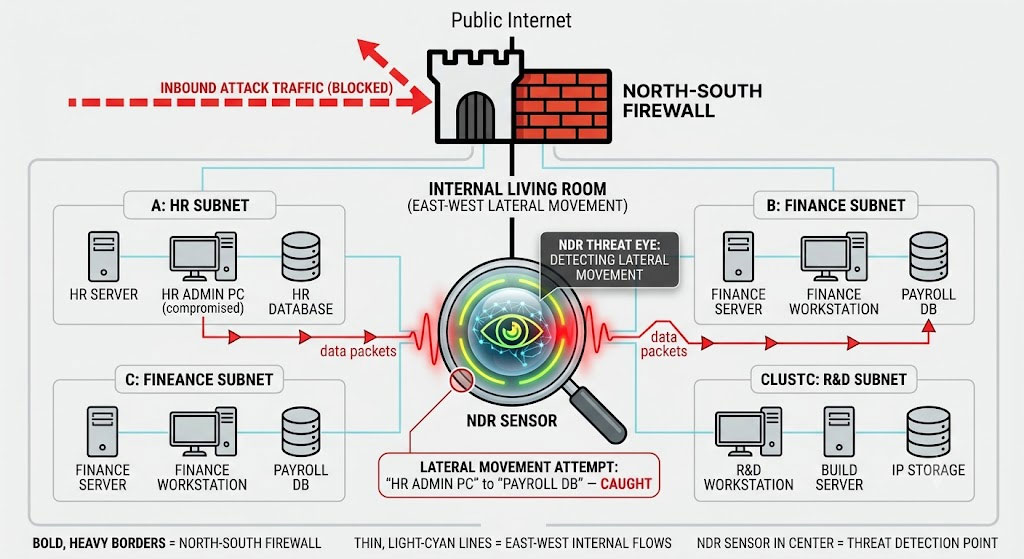
Most NDR solutions are passive observers; they tell you the house is on fire while the arsonist is already out the back door. The Trellix approach centers on "Active NDR"—the concept of built-in prevention.The real battle is won or lost in "East-West" traffic. While firewalls guard the border (North-South), NDR monitors the "internal living room" of your network.
This image is generated by AI
By catching lateral movement tactics like Ghost SPN or Kerberoasting in their infancy, active NDR provides machine-speed containment. This isn’t just alerting; it’s automated, in-line blocking at network speed. It is the difference between a localized incident and a catastrophic, enterprise-wide ransomware event.
5. The end of manual triage via contextual GenAI
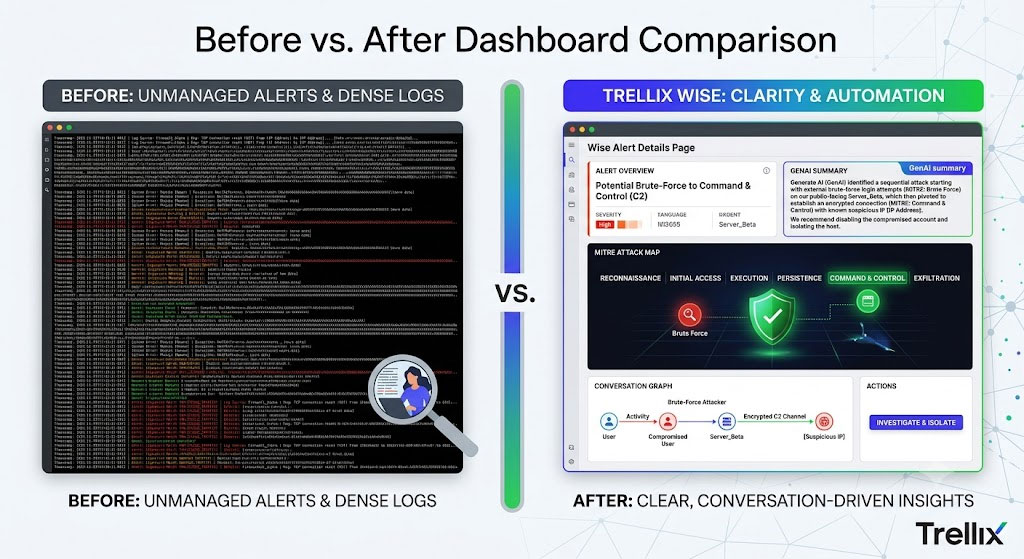
The daily life of a SOC analyst is often a soul-crushing grind through cryptic telemetry and false positives. The introduction of GenAI-powered investigation via Trellix Wise represents a fundamental shift in SOC efficiency. By utilizing Large Language Models (LLMs), the system doesn't just surface an alert; it explains the "Why" and "How." Analysts receive prioritized incidents with drafted remediation steps, allowing them to move from detection to surgical containment with absolute confidence. The metrics from this shift are staggering:
This image is generated by AI
This image is generated by AI
Conclusion: The future of the unseen battle
As our environments grow more complex—integrating hybrid cloud, managed data centers, and OT convergence—the network remains the only constant. Whether it’s a PLC change in a factory or a credential theft in the cloud, the network sees it all. Trellix has been recognized as a Visionary by Gartner for this very reason: a commitment to specialized technical innovation like "Network DVR" capabilities that allow security teams to go "back in time" to investigate zero-days weeks after they occurred.The question for every modern CISO is no longer about which agents to deploy. The question is: In an era of action chaining and unmanaged devices, is your security stack watching what's happening between your servers, or are you just hoping the agents catch the thief at the door?
Stop being a passive observer of your network's exploitation. Request a demo to see the only NDR that fights back in action, or view our solution brief to learn how to disrupt sophisticated threats at network speed.
RECENT NEWS
-
Oct 13, 2026
Trellix redefines cyber defense for the AI era
-
Oct 13, 2026
Trellix research reveals the true cost of ungoverned AI
-
Aug 24, 2026
Trellix Expands Leadership Team to Accelerate Growth and Cyber Resilience
-
May 19, 2026
Trellix Appoints Joe Chen as Chief Technology Officer
-
Apr 08, 2026
Trellix prevents enterprise data exposure in sanctioned and shadow AI
RECENT STORIES
Latest from our newsroom
Get the latest
Stay up to date with the latest cybersecurity trends, best practices, security vulnerabilities, and so much more.
Zero spam. Unsubscribe at any time.